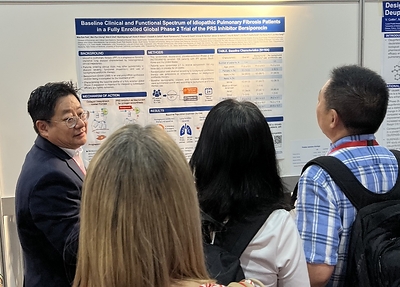
BARCELONA, Spain and SEOUL, South Korea, Sept. 24, 2026 /PRNewswire/ -- Daewoong Pharmaceutical (Co-CEOs Seongsoo Park and Changjae Lee) announced that it presented a poster on the baseline characteristics of all 104 patients enrolled in the global Phase 2 clinical trial of its idiopathic pulmonary fibrosis (IPF) drug candidate 'Bersiporocin (DWN12088)' at the European Respiratory Society (ERS) Congress 2026, held on September 6 (local time) in Barcelona, Spain.
Idiopathic Pulmonary Fibrosis is a disease in which various inflammatory and fibrotic signals interact, leading to excessive production and accumulation of collagen. Bersiporocin, being developed by Daewoong Pharmaceutical, selectively inhibits prolyl-tRNA synthetase (PRS), thereby reducing excessive collagen production associated with fibrosis.
Bersiporocin has a differentiated mechanism of action that targets collagen synthesis downstream of multiple profibrotic signals through PRS inhibition. Based on this distinct mechanism, it is being evaluated both in patients receiving background antifibrotic therapy and in those not receiving such treatment.
This presentation analyzed the baseline clinical and functional characteristics of all IPF patients recruited in South Korea and the United States. Following the presentation of interim enrollment data at KATRDIC 2025, Daewoong Pharmaceutical presented baseline data from the fully enrolled study population for the first time at ERS 2026.
The analysis showed that of the total 104 patients, 55 (52.9%) were from South Korea and 49 (47.1%) from the US. A total of 71 patients (68.3%) were receiving background antifibrotic therapy, while 33 patients (31.7%) were not. Mean forced vital capacity (FVC) was approximately 77% predicted, while mean diffusing capacity of the lungs for carbon monoxide (DLCO) was approximately 51% predicted. Overall, baseline clinical and functional characteristics were generally similar between patients with and without background antifibrotic therapy.
The ongoing global Phase 2 study is a randomized, double-blind, placebo-controlled trial taking place in South Korea and the US. Patients receive either Bersiporocin or a placebo twice daily for 24 weeks, with concomitant use of pirfenidone or nintedanib permitted. The study design reflects real-world IPF treatment settings by including patients both with and without background antifibrotic therapy.
This baseline analysis provides important context for interpreting the Phase 2 efficacy and safety results. Daewoong Pharmaceutical plans to announce top-line Phase 2 results in the first half of 2027.
Meanwhile, Bersiporocin has received Orphan Drug Designation and Fast Track status from the US FDA, as well as Orphan Drug Designation from the European Medicines Agency (EMA), driving its global development forward.
Professor Moo Suk Park of the Department of Pulmonology at Severance Hospital, who participated in the study, said, "This study provides a comprehensive overview of the baseline characteristics of 104 IPF patients enrolled in South Korea and the US. As the study includes patients both with and without background antifibrotic therapy, these baseline data will provide important context for interpreting the efficacy and safety outcomes of Bersiporocin."
Seongsoo Park, CEO of Daewoong Pharmaceutical, stated, "Successfully completing enrollment for the global Phase 2 trial and sharing the full baseline patient profile at ERS 2026 marks a significant milestone in Bersiporocin's development. We will continue to advance the program toward top-line Phase 2 results in H1 2027 and use these findings to inform subsequent global development."
[Reference]
https://drive.google.com/file/d/1XSXImvc5mcgdoSozP_B4BnDlsTW7Pfz_/view
Link to the poster: 'Baseline Clinical and Functional Spectrum of Idiopathic Pulmonary Fibrosis Patients in a Fully Enrolled Global Phase 2 Trial of the PRS Inhibitor Bersiporocin'

 View original content to download multimedia:https://www.prnewswire.co.uk/news-releases/daewoong-pharmaceutical-presents-baseline-characteristics-of-104-patients-in-global-phase-2-trial-for-ipf-drug-candidate-bersiporocin-at-ers-2026-302886913.html

Die Österreichischen Bundesbahnen (ÖBB) holen den Bahnhofskomplex Wien-Mitte nach rund zwei Jahrzehnten wieder vollständig in den eigenen Konzern zurück. Der Aufsichtsrat der ÖBB-Infrastruktur AG hat dem Rückkauf des Areals, das 2005 an die damalige BA/CA-Gruppe verkauft worden war, zugestimmt. Verkäufer ist nun eine Investorengruppe unter Führung von Morgan Stanley Real Estate Investing. Neben den Bahnanlagen umfasst die Transaktion auch das Einkaufszentrum "The Mall" sowie umfangreiche Büroflächen. Über den Kaufpreis wurde Stillschweigen vereinbart; der Abschluss steht noch unter dem Vorbehalt der kartellrechtlichen Genehmigung und ist für Ende Dezember geplant.
Mit der Übernahme würden Immobilie und Bahninfrastruktur erstmals seit mehr als zwanzig Jahren wieder in einer Hand zusammengeführt. Wien-Mitte ist gemessen an den Fahrgastzahlen der viertgrößte Bahnhof Österreichs und ein zentraler Verkehrsknoten, an dem sich S-Bahn, mehrere U-Bahn-Linien sowie der Flughafenzug CAT treffen. Täglich halten nach Angaben der ÖBB fast 600 Züge an dem Standort. Bahnanlagen und Gebäude seien baulich und technisch eng miteinander verbunden, heißt es. Künftige Änderungen an Zugängen, Stiegen, Belüftung oder Leitungen müssen damit nicht mehr mit einem externen Immobilieneigentümer abgestimmt werden.
Die ÖBB sehen in dem Rückkauf einen strategischen Schritt, um die Entwicklung des Standorts aus einer Hand zu steuern. Das soll zusätzlichen Handlungsspielraum für die kommenden Jahrzehnte schaffen, in denen die derzeit modernisierte S-Bahn-Stammstrecke mehr Züge aufnehmen soll. Die Funktion des Standorts als Bahnhof soll nach Angaben des Unternehmens wieder stärker im Namen, an den Zugängen und in der architektonischen Gestaltung zum Ausdruck kommen. Für die bestehenden Mietverhältnisse im Einkaufszentrum und in den Büros kündigte die ÖBB an, dass diese unverändert weitergelten.
Wien-Mitte blickt auf eine lange und wechselvolle Geschichte zurück. Der Standort wurde 1848 als Bahnhof Hauptzollamt eröffnet und ging 1934 in das Eigentum der Bahn über. Ab den späten 1950er-Jahren entstanden über den Gleisen unter anderem ein Bürotrakt und eine Markthalle, bevor die Liegenschaft 2005 veräußert wurde. Die spätere Entwicklung des Areals war von intensiven öffentlichen Debatten begleitet, unter anderem wegen geplanter Hochhäuser mit bis zu 97 Metern Höhe und der Diskussion um mögliche Auswirkungen auf den UNESCO-Welterbestatus. Mit der nun geplanten Re-Integration in den ÖBB-Konzern verknüpft das Unternehmen die Aussicht, die verkehrliche Rolle des Standorts und die bauliche Entwicklung langfristig aufeinander abzustimmen.