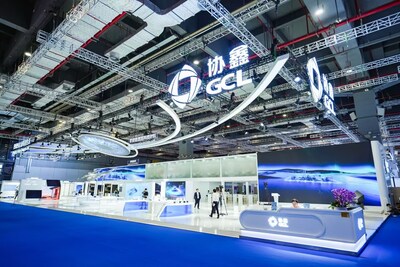
SHANGHAI, June 12, 2026 /PRNewswire/ -- GCL System Integration Technology Co., Ltd. ("GCL SI" or "the Company") has showcased its scenario-based PV solutions at the SNEC 2026 which was held in Shanghai, China from June 3 to 5. GCL SI showcased a comprehensive multi-matrix product portfolio, including high-efficiency TOPCon and BC modules, scenario-based component solutions, and mobile green energy systems. The exhibition highlighted the Company's latest achievements across four strategic dimensions: high-efficiency cells, scenario-based solutions, mobile energy, and ecosystem development.
Advancing Application-Specific Solar Deployment
The photovoltaic industry is evolving from scale-driven growth toward value creation through more precise and differentiated applications. To address this shift, GCL SI showcased five scenario-specific module solutions: anti-dust modules for commercial and industrial applications, anti-glare modules for airports and highways, high-efficiency modules for utility-scale ground-mounted projects, steel-frame modules for 2,000V desert PV applications, and composite-frame modules for marine environments. Covering land, sea, high altitude, typhoon zones, and corrosive environments, this scenario-based approach is designed to address the varying performance, reliability and economic requirements of different deployment environments.
For extreme wind and high‑altitude environments, GCL SI's steel-frame modules offer twice the tear resistance of traditional aluminum frames, withstanding extreme wind conditions of up to 60 m/s in typhoon-prone regions while improving overall project economics compared with conventional aluminum-frame designs. For harsh high-salt, high-humidity and high-heat offshore conditions, the marine-specific modules feature double-coated glass, high-water-resistance encapsulants, and full-structure protection, passing top-level salt spray and rigorous reliability tests to solve corrosion, hot spot, and aging challenges. In the commercial and industrial distributed PV market, the S-series anti-dust modules combine high-density encapsulation, full-screen anti-dust design, and advanced sealing for enhanced reliability.
GCL SI's focus on product quality and reliability was further validated by its designation as a 2026 Kiwa-PVEL TOP PERFORMER, one of the photovoltaic industry's most widely recognized benchmarks for module performance and reliability.
Digitalization Supporting Low-Carbon Value Creation
GCL SI, together with Ant Digital Technologies, launched "GCL Carbon Chain 3.0" at SNEC 2026 and initiated the Carbon Chain 4.0 roadmap.
Leveraging GCL SI's deep industry expertise in PV manufacturing, supply chain management, and low-carbon product innovation, and supported by Ant Digital's blockchain, AI and digital technologies, Carbon Chain 3.0 establishes a product carbon footprint monitoring and verification mechanism. The platform integrates carbon footprint management across procurement, manufacturing and delivery processes, enhancing transparency and supporting low-carbon value creation throughout the supply chain. Additionally, GCL SI has enhanced its integrated "module + green certificate" service capability, offering green asset solutions for both domestic and international markets.
GCL SI is also translating its application-driven strategy into international markets through targeted partnerships. In Africa, the company is collaborating with PowerChina Guiyang Engineering Corporation to develop off-grid integrated solar-storage solutions. In Latin America, GCL SI is deepening its strategic partnership with Coexito to strengthen channel presence and brand positioning.
On the ecosystem front, GCL SI is working with Ant Digital Technologies and Digital China to advance digital energy ecosystem development, integrating blockchain, AI, and data governance to build a smarter, more connected clean energy future.
Looking ahead, GCL SI believes the next phase of solar industry growth will be driven by solutions that deliver superior performance, sustainability, and application-specific value. The company will continue to advance technologies that support the evolving needs of global energy markets.
Photo - https://mma.prnewswire.com/media/2996595/9c56599875b056fa1baedecb0ed8295c.jpg
 View original content:https://www.prnewswire.co.uk/news-releases/gcl-si-showcases-scenario-based-pv-solutions-at-snec-2026-driving-application-specific-solar-deployment-and-low-carbon-development-302798756.html

Der Asbest-Skandal rund um mehrere Steinbrüche im Burgenland entwickelt sich zu einer Milliardenbelastung für die öffentliche Hand. Nach einer neuen Berechnung der Umweltorganisation Greenpeace wird der materielle Schaden durch Entsorgung und Sanierung mindestens 1,6 Milliarden Euro betragen. Betroffen sind nicht nur das Burgenland, sondern auch Teile der Steiermark, Niederösterreichs sowie Gebiete in Ungarn, in die asbesthaltiges Material geliefert oder verbaut wurde.
Grundlage der Kostenschätzung ist die Annahme, dass seit 1990 rund 26 Millionen Tonnen asbesthaltiges Gestein aus vier Steinbrüchen abgebaut wurden. Greenpeace geht davon aus, dass etwa 20 Millionen Tonnen kurz- oder langfristig auf Asbestdeponien landen werden, während der Rest als Straßenunterbau, Fundamente oder in privaten Gärten in der Umwelt verbleibt und kaum mehr rückholbar ist. Rund 20 Prozent des Abfalls sollen in Form von asbesthaltigem Asphalt anfallen, dessen Deponierung besonders aufwendig ist und künftige Straßensanierungen über Jahrzehnte verteuern dürfte.
Mindestens drei Viertel der veranschlagten 1,6 Milliarden Euro entfallen laut Greenpeace auf die Entsorgung des Materials, der Rest auf Sanierungen. Für die Rechnung wurde ein Entsorgungspreis von lediglich 50 Euro je Tonne angesetzt – etwa die Hälfte des vor Bekanntwerden des Skandals üblichen Marktpreises. Diese Kalkulation sei nur zu halten, wenn rasch neue, sichere und kostengünstige Deponien errichtet werden, etwa in bereits geschlossenen Steinbrüchen, argumentiert Greenpeace. Andernfalls könnten sich die Gesamtkosten nach Einschätzung der Organisation auf mindestens das Doppelte erhöhen.
Die von Greenpeace genannten Summen übersteigen die Umsätze der betroffenen Steinbruchbetreiber deutlich und dürften auch die finanziellen Möglichkeiten des Landes Burgenland überfordern. Die Umweltorganisation drängt daher auf ein Eingreifen des Bundes und fordert, Mittel aus der Katastrophenhilfe bereitzustellen und einen Rahmen für eine kostengünstige Entsorgung zu schaffen. Zugleich verweist sie auf die Verantwortung des zuständigen Umweltministers, für ausreichend Deponiekapazitäten zu sorgen, um Kostenrisiken zu begrenzen und die logistisch aufwendige Räumung der asbestbelasteten Materialien langfristig planbar zu machen.