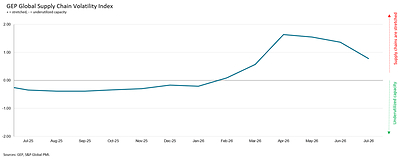
CLARK, N.J., Aug. 12, 2026 /PRNewswire/ -- GEP Global Supply Chain Volatility Index — a leading indicator tracking demand conditions, shortages, transportation costs, inventories and backlogs, based on a monthly survey of 27,000 businesses — showed global supply chain pressures eased in July as manufacturers reduced precautionary stockpiling and transportation pressures moderated. However, supply shortages remained elevated and production backlogs continued to build, indicating supply chains had yet to fully recover before the renewed disruption in the Strait of Hormuz.
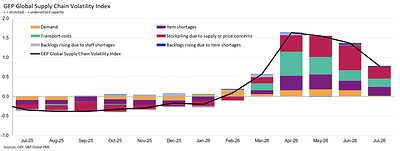
The survey was mostly conducted before the latest escalation in the Middle East and renewed disruption to shipping through the Strait of Hormuz, providing a snapshot of global supply chains immediately before energy prices and geopolitical uncertainty increased again.
Manufacturers scaled back safety-stock building in July following a three-and-a-half-year peak in the second quarter of 2026, suggesting businesses believed supply risks were beginning to ease. Transportation costs also moderated, helping drive the overall improvement in global supply chain conditions.
Despite the easing, reports of critical items in short supply remained elevated globally, while manufacturers continued reporting rising production backlogs caused by missing materials and components. This indicates supply bottlenecks remain unresolved and could worsen if geopolitical tensions persist.
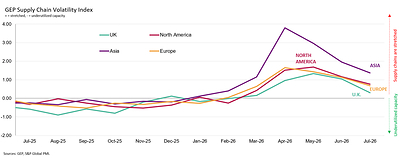
Demand for raw materials and commodities remained strongest across Asia and North America, where manufacturers continued purchasing inputs at a significantly faster pace than other major regions. Europe, by contrast, remained comparatively subdued, reflecting weaker manufacturing order books and lower inventory building.
Interpreting the data:
Index > 0, supply chain capacity is being stretched. The further above 0, the more stretched supply chains are.
Index < 0, supply chain capacity is being underutilized. The further below 0, the more underutilized supply chains are.
JULY 2026 REGIONAL KEY FINDINGS
JULY 2026 KEY FINDINGS
For more information, visit www.gep.com/volatility.
Note: Full historical data dating back to January 2005 is available for subscription. Please contact economics@spglobal.com.
The next release of the GEP Global Supply Chain Volatility Index will be 8 a.m. ET, Sep. 11, 2026.
About the GEP Global Supply Chain Volatility Index
The GEP Global Supply Chain Volatility Index is produced by S&P Global and GEP. It is derived from S&P Global's PMI® surveys, sent to companies in over 40 countries, totaling around 27,000 companies. The headline figure is a weighted sum of six sub-indices derived from PMI data, PMI Comments Trackers and PMI Commodity Price & Supply Indicators compiled by S&P Global.
A Supply Chain Volatility Index is also published at a regional level for Europe, Asia, North America and the U.K. For more information about the methodology, click here.
Media Contacts
Derek Creevey
Director, Public Relations
GEP
Phone: +1 646-276-4579
Email: derek.creevey@gep.com
Joe Hayes
Senior Principal Economist
S&P Global Market Intelligence
Phone: +44-1344-328-099
Email: joe.hayes@spglobal.com
S&P Global Market Intelligence
Corporate Communications
Email: Press.mi@spglobal.com

 View original content to download multimedia:https://www.prnewswire.co.uk/news-releases/global-supply-chain-pressures-ease-in-july-but-shortages-persist-ahead-of-renewed-strait-of-hormuz-disruption-gep-global-supply-chain-volatility-index-302849802.html

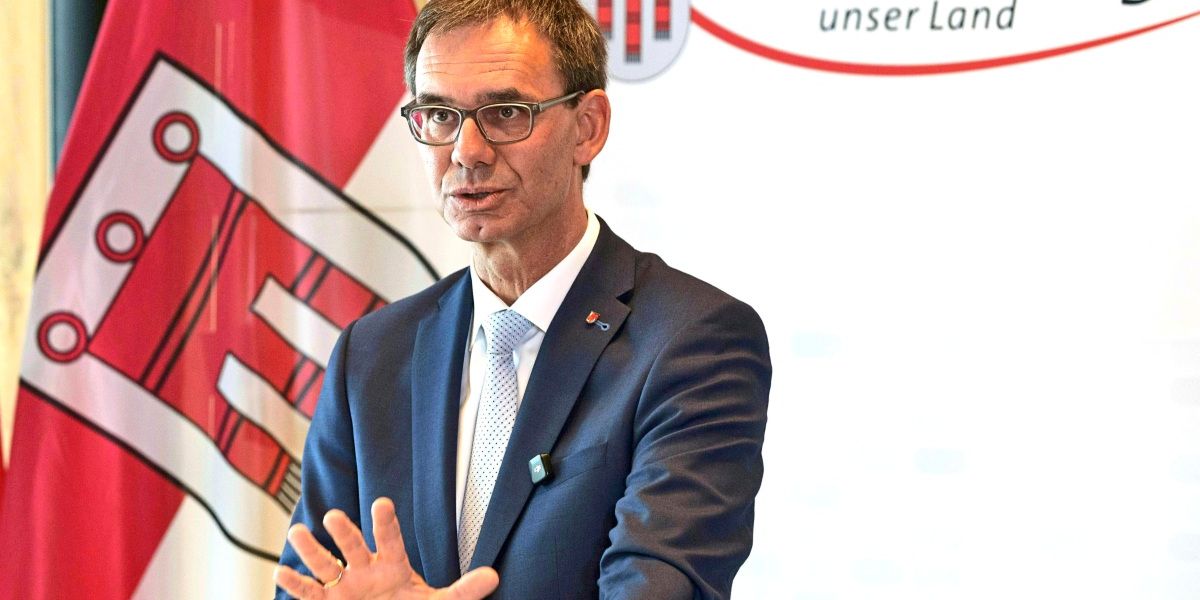
Vorarlbergs Landeshauptmann Markus Wallner (ÖVP) hat die innenpolitische Debatte über den Umgang mit Jugendkriminalität und die Ausgestaltung des Sozialsystems neu angeheizt. In der ORF-„Pressestunde“ brachte der Vorsitzende der Landeshauptleutekonferenz die seit Jahren umstrittene Forderung seiner Partei erneut auf den Tisch, die Strafmündigkeit in Österreich von derzeit 14 auf zwölf Jahre zu senken. „Wer früh Grenzen übertritt, der muss auch damit rechnen, dass früh Grenzen aufgezeigt werden“, sagte Wallner. Allein mit Strafrecht sei es aus seiner Sicht jedoch nicht getan; parallel brauche es ein „Netz an verpflichtenden Unterstützungen“ für betroffene Kinder und Familien.
Zur Begründung verwies Wallner auf Entwicklungen in Schweden. Dort werde über Gefängnisstrafen für 13-Jährige diskutiert, nachdem Berichte über Jugendliche kursierten, die von erwachsenen Tätern für Straftaten instrumentalisiert werden sollen. Eine „Situation wie in den Vororten Stockholms“ wolle er in Österreich verhindern, so der Landeshauptmann, der betonte, er wolle „nicht den Teufel an die Wand malen“, aber vor Fehlentwicklungen warnen. Die ÖVP hatte bereits 2024, unter anderem nach Fällen von Jugendkriminalität, eine Absenkung der Strafmündigkeit gefordert; damals war Innenminister Gerhard Karner treibende Kraft der Debatte.
In der früheren schwarz-grünen Koalition konnte sich die Volkspartei mit dieser Linie nicht durchsetzen. „Mit den Grünen war das aber praktisch unmöglich“, sagte Wallner rückblickend. Aus den Reihen der Grünen kam auch diesmal umgehend Widerspruch. Die grüne Sicherheitssprecherin Agnes Sirkka Prammer bezeichnete es als „Scheinlösung“, Zwölfjährigen mit dem Strafrecht zu begegnen, und plädierte für einen Schwerpunkt auf Prävention: Kinder- und Jugendhilfe, Familienarbeit, Schulsozialarbeit und psychologische Unterstützung müssten ausgebaut werden. Die Länder seien gefordert, dafür ausreichend Ressourcen bereitzustellen.
Parallel zu der Sicherheitsdebatte positionierte sich Wallner bei der anstehenden Neuordnung der Sozialhilfe, einem der zentralen Themen, über die sich die Bundesregierung im Herbst verständigen will. Die Verhandlungen laufen bereits, in der kommenden Woche sollen sie fortgesetzt werden. Wallner betonte, es brauche „eine Sozialhilfe, die Armut verhindert“, warnte aber zugleich vor einer möglichen „Zuwanderung ins System“ und forderte klare Wartefristen für Asylberechtigte. Die Reform müsse auf eine möglichst kurze Bezugsdauer abzielen; Vorarlberg sei hier, was die Dauer des Sozialhilfebezugs betreffe, Vorreiter.
Bei den Leistungen spricht sich Wallner für eine Obergrenze aus. „Ohne Obergrenze wird es nicht gehen“, sagte er mit Blick auf die Gesamtsumme, die ein Haushalt aus der Sozialhilfe beziehen kann. Auch gestaffelte Kinderregelsätze seien aus seiner Sicht notwendig. Jedes Kind sei „gleich viel wert“, aber die Kosten verdreifachten sich nicht automatisch bei drei Kindern, argumentierte der Landeshauptmann. Die neue Sozialhilfe soll nach aktueller Planung mit 1. Jänner 2027 in Kraft treten. Ob der enge Zeitplan hält, ließ Wallner offen, fügte aber hinzu: „Wenn man will, schon“ – und appellierte daran, die Bundesländer „möglichst schnell an den Tisch zu holen“.