SINGAPORE, Aug. 31, 2026 /PRNewswire/ -- Active travel or 'sportcations' are becoming the next big travel trend, with Trip.com Group seeing a strong double-digit increase in booking GMV. From cycling through mountain passes to joining diving camps and wellness retreats, active travel is becoming a defining part of how people experience the world.

A growing passion for active travel
This shift is gathering pace across the full travel journey, with searches for active sports experiences growing by over 30% year on year, with markets witnessing substantial increases: 80% in Singapore, 65% in Malaysia, and 50% in the United Kingdom, while France, Italy, Germany, and Spain all recorded triple-digit growth.
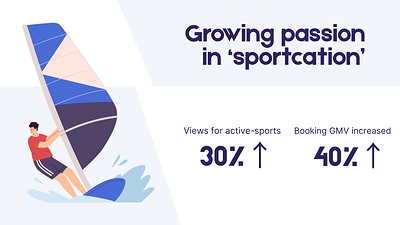
Total travel booking GMV has increased by almost 40%, with markets such as South Korea (+150%), Singapore (+104%), and Thailand (+200%) seeing bookings more than double over the past year. The same is seen for European travellers. The United Kingdom saw bookings grow by over 100%, and Germany by over 600%, highlighting that travellers are increasingly planning holidays around experiences that get them moving.
From adrenaline to adventure, travellers are following their passions
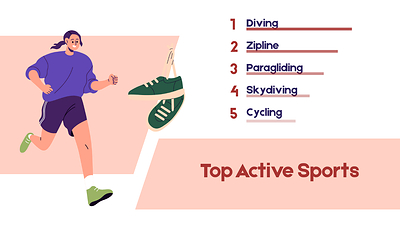
Active travel is taking many forms, reflecting the wide range of interests shaping today's holidays. Globally, diving ranks as the most-booked sporting experience, followed by activities such as ziplining, paragliding, skydiving and cycling.
Across individual markets, preferences vary, giving destinations their own unique sporting identities. Adventure activities prove especially popular across Asia. Diving leads bookings in South Korea, Malaysia, Germany, Spain, Italy and France. At the same time, skydiving ranks first in Hong Kong, Taiwan and Thailand, while Japanese travellers show the strongest preference for cycling.
Destinations are driving signature experiences
As travellers increasingly build holidays around the activities they love, certain places are emerging as go-to destinations for particular passions. The data shows that five destinations in particular stand out across multiple types of active travel, with Thailand, China, Australia, New Zealand and Malaysia appearing among the leading destinations across cycling, climbing, swimming, water sports and adventure experiences.
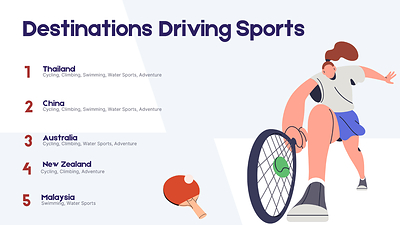
Thailand leads the way, appearing across all five categories and ranking as the leading destination for diving, while also featuring among the top destinations for cycling, water sports and adventure activities. This breadth of experiences makes it a particularly strong destination for travellers looking to combine different activities within one trip.
Australia stands out as another versatile destination, attracting travellers for cycling, rock climbing, surfing and kayaking, as well as adventure activities such as paragliding and skydiving. Its presence across multiple categories reflects the growing appeal of destinations where travellers can combine diverse active experiences within the same holiday.
From travelling together to inspiring others
While the passion for active experiences is shared globally, the way people travel differs across regions. In Europe, the average travel party is 1-2 people, suggesting many travellers are embarking on solo adventures or trips with a partner. Across the Asia-Pacific region, the average group size increases to 2-3, highlighting the popularity of travelling with friends and family to share new experiences.
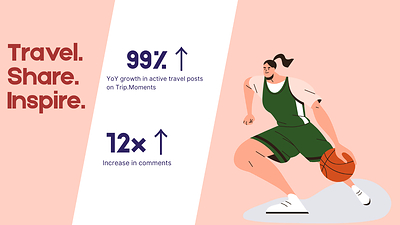
These experiences are also shaping how travellers engage online. Active travel-related posts on Trip.Moments have nearly doubled globally, growing by 99% year on year as more travellers document their adventures and inspire others to follow in their footsteps. Several markets have seen particularly strong growth in community sharing, including Spain (224.9%), the United Kingdom (122.2%), Italy (118.9%), China (96.2%) and France (86.9%), reflecting the growing popularity of active travel across both Asia and Europe.
The conversations are becoming more engaging, too. While the number of posts has nearly doubled, comments have grown twelvefold compared with the previous year, demonstrating that active travel is encouraging richer conversations rather than simply more content. From destination tips to training advice and first-hand recommendations, travellers are helping one another discover their next active escape, creating a cycle where inspiration leads to bookings and every journey inspires the next.
As travellers continue looking for more meaningful ways to explore the world, active travel is evolving from a niche interest into a mainstream travel trend. Whether it is mastering a new skill, training for a personal goal or simply enjoying the outdoors, active experiences are helping people build stronger connections with destinations and with each other.
About Trip.com Group
Trip.com Group is a global travel service provider comprising of Trip.com, Ctrip, Skyscanner, and Qunar. Across its platforms, Trip.com Group helps travellers around the world make informed and cost-effective bookings for travel products and services and enables partners to connect their offerings with users through the aggregation of travel-related content and resources, and an advanced transaction platform consisting of apps, websites and 24/7 customer service centres. Founded in 1999 and listed on NASDAQ in 2003 and HKEX in 2021, Trip.com Group is on the mission "to pursue the perfect trip for a better world". Find out more about Trip.com Group here: group.trip.com.
Follow us on: X, Facebook, LinkedIn, and YouTube.

 View original content to download multimedia:https://www.prnewswire.co.uk/news-releases/growing-sportcation-travel-trend-tripcom-group-reports-40-increase-in-active-travel-booking-gmv-302864622.html

Mercedes-Benz verzeichnet ein zunehmend zweigeteiltes Bild seiner weltweiten Fahrzeugverkäufe. Während die Konzernzahlen im dritten Quartal 2026 global rückläufig waren, meldet die Indien-Tochter ein Rekordquartal. In Indien setzte Mercedes-Benz im Zeitraum Juli bis September 5.422 Fahrzeuge ab, ein Plus von 6 Prozent gegenüber dem Vorjahr und zugleich der beste Quartalswert in der Geschichte des Unternehmens im Land. Von Januar bis September summierten sich die Verkäufe dort auf 15.190 Einheiten, rund 8 Prozent mehr als im entsprechenden Vorjahreszeitraum.
Auf Konzernebene dagegen schrumpften die Auslieferungen im gleichen Quartal. Weltweit setzte Mercedes-Benz 491.700 Pkw und leichte Nutzfahrzeuge ab, ein Minus von 6 Prozent im Vergleich zum Vorjahr. Im Pkw-Geschäft allein sanken die globalen Verkäufe um 8 Prozent auf 407.200 Einheiten. Besonders belastend wirkte die Entwicklung in Asien und hier vor allem in China: In der Volksrepublik gingen die Pkw-Verkäufe um knapp ein Drittel auf 86.800 Fahrzeuge zurück, konzernweit meldete der Hersteller für Asien ein Minus von 25 Prozent auf 132.300 Autos. Ein Zuwachs in Europa und Nordamerika reichte nicht aus, um die Schwäche in China zu kompensieren.
Kontrastreich präsentiert sich auch das Bild in den oberen Preissegmenten. In Indien trugen Top-End-Luxusmodelle – darunter S‑Klasse, Mercedes‑Maybach, EQS Maybach SUV, G‑Klasse, V‑Klasse und AMG‑Modelle – maßgeblich zum Wachstum bei: Diese Klasse legte dort im Jahresvergleich um mehr als 13 Prozent zu und kam auf über ein Viertel des Gesamtabsatzes. Innerhalb dieses Segments nutzten laut Unternehmen fast drei Viertel der Kunden das MANUFAKTUR‑Personalisierungsprogramm. Die Performance-Marke AMG steigerte ihre Auslieferungen in Indien um mehr als 18 Prozent, das AMG G 63 erzielte den höchsten monatlichen Absatz seit Markteinführung. Global hingegen verzeichnete Mercedes-Benz im teuersten Segment aus S‑Klasse, Maybach und AMG ein deutliches Minus von gut 20 Prozent im dritten Quartal.
Stärker als die Verbrenner legten weltweit die batterieelektrischen Modelle zu. Vertriebs- und Marketingvorstand Mathias Geisen sprach von dem höchsten Quartalsabsatz vollelektrischer Pkw in der Unternehmensgeschichte; in Europa war nahezu jedes dritte verkaufte Auto rein elektrisch. Der elektrische GLC trug dabei überproportional zum Wachstum bei und vervielfachte seine Verkäufe gegenüber dem zweiten Quartal. In Indien setzt der Konzern seinen Fokus ebenfalls auf Elektrifizierung: Dort stehen die Markteinführung einer elektrifizierten S‑Klasse mit Auslieferungsstart Mitte Oktober sowie die Premiere des GLC BEV Anfang November an, die das Portfolio am Subkontinent weiter ausbauen sollen.
Die Transportersparte Vans erwies sich zuletzt als Stabilitätsanker. Mit einem Plus von 1 Prozent auf 84.400 Fahrzeuge hielt sich das Segment im dritten Quartal nahezu auf Vorjahresniveau. Insgesamt aber bleibt der Druck auf das Kerngeschäft hoch, da der Wettbewerb im wichtigen Markt China nach Konzernangaben intensiv und das Umfeld weiterhin schwierig ist. In dem Land gehören der GLC und die E‑Klasse zu den meistverkauften Baureihen des Herstellers und machen dort fast zwei Drittel der Pkw-Verkäufe aus. Die anhaltende Schwäche in China, die bereits im zweiten Quartal mit einem Absatzminus von rund 30 Prozent sichtbar war, unterstreicht für Mercedes-Benz die Bedeutung eines breiter diversifizierten Wachstums – mit Märkten wie Indien, in denen das Premium- und Luxusgeschäft derzeit gegensätzlich zum Trend zulegt.