BEIJING, Sept. 20, 2026 /PRNewswire/ -- JA announced that its independently developed and packaged P-type heterojunction (P-HJT) modules were successfully launched on September 17 and entered their planned orbit.
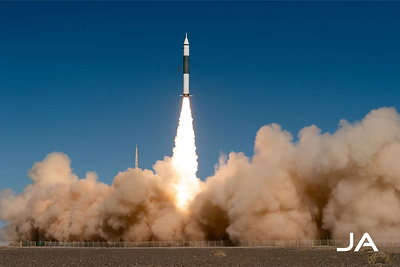
The mission marks JA's first in-orbit test of P-HJT modules, with future large-scale commercial applications as a long-term goal.
"Energy innovation has long been a driving force behind human progress," said Dr. Ouyang Zi, Chief Technology Officer of JA. "As satellite deployment accelerates and the space economy expands, solar power is expected to play an increasingly important role in future space infrastructure. Developing more cost-competitive solar solutions for space is therefore an important strategic priority.
"JA has spent years building expertise in photovoltaic technology, with the reliability and long-term performance of its products proven through large-scale manufacturing and deployment across a wide range of terrestrial applications. This in-orbit test extends those capabilities into the space environment and marks an important step in JA's exploration of future space energy solutions.
"Through real-world testing in orbit, we aim to assess the reliability and degradation of crystalline silicon technology in low-Earth orbit and explore more cost-competitive options for future space energy systems. The technology will require long-term validation, but we believe it is a direction worth pursuing."
In orbit, the JA modules will be exposed to harsh conditions, including intense radiation, high-energy particles and extreme temperature swings. By comparing in-orbit performance data with results from ground-based simulations, JA will assess the long-term reliability and degradation of P-HJT technology in low-Earth orbit.
If the validation targets are achieved, the program could help accelerate the adoption of mature crystalline silicon technologies as an alternative to gallium arsenide in low-Earth-orbit applications, potentially lowering the cost of satellite power systems. It could also support the development of satellite internet, remote sensing, space communications, space-based computing and other low-Earth-orbit applications.
JA will use the mission as a starting point to further strengthen its module R&D and manufacturing capabilities and advance scalable energy solutions for space exploration and commercial space applications.
Space PV remains at an early stage of exploration and validation, and large-scale commercialization remains highly uncertain. JA currently has no orders related to space PV, and the program has no material impact on its current operating performance.
 View original content to download multimedia:https://www.prnewswire.co.uk/news-releases/jas-space-pv-products-reach-orbit-starting-space-validation-302883945.html

Die Festnahme des freien Journalisten Michael Bonvalot bei einer Versammlung in Steyr entwickelt sich in Österreich zu einem politischen Streitfall über das Verhältnis von Polizei, Demonstrationsrecht und Pressefreiheit. Bonvalot wollte nach eigenen Angaben am vergangenen Sonntag über einen „Aufmarsch der rechten Verschwörungsszene“ berichten, als er trotz gültigem Presseausweis von Einsatzkräften abgeführt wurde. Inzwischen ist ein Video des Vorfalls online, das die Debatte zusätzlich anheizt.
Steyrs Bürgermeister Markus Vogl (SPÖ) machte den Einsatz beim Sicherheitsgipfel mit der Polizei zum Thema und sprach von einem Vorgang, der „schwer zu verdauen“ sei. Nicht nur die Versammlungsfreiheit sei ein „hohes Gut“, betonte er, sondern ebenso die Pressefreiheit. Journalisten müssten bei solchen Einsätzen genauso geschützt werden wie Demonstrationsteilnehmer. Laut Vogl hatte Bonvalot aus rund 50 Metern Abstand berichten sollen und sich mit einem gültigen Presseausweis ausgewiesen.
Der Bürgermeister knüpfte seine Kritik an eine breitere Auseinandersetzung über die seit Jahren stattfindenden sonntäglichen Aufmärsche in Steyr. Diese sogenannten Spaziergänge, deren jüngste Ausgabe die 300. gewesen sein soll, hätten sich nach seinen Worten „bedauerlicherweise zu einer Anlaufstelle für demokratiefeindliche Gruppen“ entwickelt – mit prominenter Beteiligung von Szenefiguren wie Gottfried Küssel und Ken Jebsen. Während die Polizei bislang keine Gründe für ein Verbot dieser Versammlungen gesehen habe, entstehe nun der Eindruck, dass gegenüber einem Berichterstatter mit „zweierlei Maß“ gemessen werde. Vogl fordert von der Exekutive daher „vertrauensbildende Maßnahmen“; der Eindruck, polizeijuristische Einschätzungen gälten nicht für alle gleich, sei „untragbar“.
Innenminister Gerhard Karner (ÖVP) stellte sich demonstrativ hinter die Einsatzkräfte. Er verteidigte das Vorgehen der Polizei am Donnerstag als „verhältnismäßig und korrekt“ und widersprach damit der Darstellung, es handle sich um einen unverhältnismäßigen Eingriff in die Arbeit der Medien. Details zu der Einsatzbewertung blieben zunächst knapp, doch die veröffentlichten Videoaufnahmen dürften sowohl von Kritikern als auch von Befürwortern der Polizei genau analysiert werden. Während Vogl betont, er wolle trotz der guten bisherigen Zusammenarbeit mit der Polizei „nicht einfach zur Tagesordnung übergehen“, signalisiert das Innenministerium Rückendeckung für die Einsatzlinie vor Ort – ein Spannungsfeld, das die Diskussion über die Grenzen und den Schutz journalistischer Arbeit bei Demonstrationen weiter befeuern dürfte.