XI'AN, China, July 29, 2026 /PRNewswire/ -- LONGi is strengthening its commitment to innovation in solar mobility by supporting two of the world's leading solar racing teams at the 2026 Elektrek American Solar Challenge (ASC), one of North America's premier solar-powered endurance competitions. This year's ASC takes competitors from Minnesota to Texas, with much of the route following the historic Route 66 corridor.
Taking place from July 25 to August 1, the ASC challenges teams to cover the greatest cumulative distance over eight days, rather than compete for outright speed. As they traverse diverse climate zones and complex terrain, teams must continuously optimize energy management and strategic decision-making throughout the endurance challenge.
For LONGi, the competition serves as more than a race — it is a real-world platform for validating and advancing next-generation photovoltaic technologies.
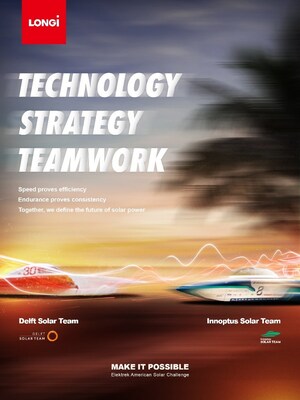
Expanding Partnerships with Two of the World's Leading Solar Racing Teams
Following its collaboration with Belgium's Innoptus Solar Team at the 2025 Bridgestone World Solar Challenge (BWSC), LONGi has further strengthened its technical collaboration within the global solar racing community.
For the 2026 season, LONGi is partnering with both Belgium's Innoptus Solar Team and the Netherlands' Delft Solar Team. Both teams ranked among the top three at the 2025 BWSC and represent the only two European teams competing in this year's Elektrek American Solar Challenge.
The expanded collaboration reflects LONGi's continued commitment to working alongside global innovators to explore the potential of photovoltaic technology through real-world engineering challenges.
High-Efficiency BC Technology at the Core
Solar racing represents one of the most challenging applications for photovoltaic technology. With extremely limited surface area available on the vehicle, every solar cell must achieve maximum conversion efficiency while maintaining reliability under dynamic operating conditions, curved vehicle surfaces, temperature variations, and long-distance endurance challenges.
To meet these requirements, LONGi provides tailored BC (Back Contact) technology solutions for both teams.
Innoptus Solar Team is equipped with LONGi's customized high-efficiency BC flexible modules, specifically designed for the curved surfaces and lightweight architecture of solar race cars. Meanwhile, Delft Solar Team integrates LONGi's high-efficiency BC solar cell strings into its vehicle's energy system.
As the vehicle's sole direct energy source, the photovoltaic system determines how effectively sunlight can be converted into usable power. High conversion efficiency, lightweight design, and operational reliability provide the foundation for innovations in aerodynamics, energy management, and vehicle control.
Technology, Strategy and Teamwork: Making Peak Performance Possible
Achieving peak performance in the Elektrek American Solar Challenge requires more than advanced photovoltaic technology alone. As the foundation of every solar race car, high-efficiency PV technology determines how much energy the vehicle can capture from sunlight and directly influences the power available throughout the journey.
Beyond the photovoltaic system, teams must continuously balance energy management, route strategy, and driving decisions based on changing sunlight conditions, weather patterns, and terrain. Every choice plays a role in maximizing the vehicle's potential and extending its range throughout the eight-day challenge.
Peak performance is also made possible through close collaboration between drivers, engineers, and technology partners. By combining technical expertise, strategic thinking, and teamwork, these collaborations transform innovative concepts into real-world performance.
Through its partnerships with leading solar racing teams, LONGi continues to explore the possibilities of high-efficiency photovoltaic technology in demanding environments, gaining valuable insights that help advance future solar applications.
Driving Innovation Beyond the Race
LONGi's partnerships with leading solar racing teams are built on technical collaboration and co-creation rather than sponsorship alone.
The company views solar motorsport as an innovation platform where advanced photovoltaic technologies can be validated, refined, and further developed under real operating conditions. technology innovation, combining expertise across industries to accelerate breakthroughs in photovoltaic performance.
The value of these partnerships extends beyond the race itself. By working together with engineers, researchers, and innovators around the world, LONGi aims not only to provide advanced solar technologies, but also to foster an open innovation ecosystem where collective insights and collaboration help expand the boundaries of what solar energy can achieve.
As the global energy system evolves toward a more sustainable and integrated future, LONGi remains committed to advancing photovoltaic innovation, strengthening collaboration across the energy ecosystem, and unlocking new possibilities for a cleaner energy transition.

Photo - https://mma.prnewswire.com/media/3008199/image1.jpg
Logo - https://mma.prnewswire.com/media/1606520/LONGi_Logo.jpg
 View original content:https://www.prnewswire.co.uk/news-releases/longi-bc-technology-powers-two-world-leading-solar-racing-teams-at-the-2026-elektrek-american-solar-challenge-302837280.html

Asfinag und ÖAMTC kombinieren emotionale Bewusstseinsbildung mit neuer Technologie, um den „Arbeitsplatz Straße“ sicherer zu machen. Unter dem Slogan „Danke, dass du auf meine Mama/meinen Papa aufpasst“ starten die Organisationen eine gemeinsame Kampagne, bei der die Kinder der Mitarbeitenden als Botschafter auftreten. Hintergrund sind mehrere schwere Unglücke mit Autobahn-Personal: Im Jahr 2025 war Asfinag-Personal in sechs Unfälle auf Autobahnen involviert, einer davon endete tödlich. Parallel zu der Kampagne wird in Österreich ein KI-basiertes Warnsystem im Live-Betrieb getestet.
Die Dimension des Problems ist erheblich. Laut Daten von Statistik Austria und ÖAMTC kam es 2025 zu insgesamt 2.137 Unfällen mit Personenschaden auf Autobahnen und Schnellstraßen, 45 davon verliefen tödlich. Als häufigste Ursachen gelten Unachtsamkeit und Ablenkung. Eine IFES-Umfrage zeigt, wie verbreitet riskantes Verhalten ist: Ein Drittel der Befragten gibt an, während der Fahrt Handy-Nachrichten zu lesen oder zu schreiben, die Hälfte bedient Navi oder Radio. Unter den unter 30-Jährigen räumen 60 Prozent ein, schon einmal während der Fahrt ein Video aufgenommen zu haben.
Das neue KI-System zielt darauf ab, die Arbeit von Straßenkolonnen unter fließendem Verkehr besser abzusichern. Auf Sicherungsfahrzeugen oder Warnleitanhängern montierte Kameras erfassen Fahrzeuge in rund 300 Metern Entfernung. Die Künstliche Intelligenz analysiert daraufhin den Fahrweg der herannahenden Fahrzeuge und löst bei Kollisionsgefahr Warnungen aus: Die Person am Steuer wird mit einem Hupsignal aufmerksam gemacht, während Straßenarbeiter ein kleines Gerät am Körper tragen, das im Gefahrenfall vibriert. Diese wenigen zusätzlichen Sekunden sollen reichen, um sich aus der Gefahrenzone zurückzuziehen.
Derzeit sind fünf Kameras im Einsatz, weitere 21 Kollisionswarner werden angeschafft. Der Testbetrieb läuft bis Jahresende, anschließend soll über eine flächendeckende Einführung entschieden werden. Auch der ÖAMTC erprobt die Technologie im praktischen Alltag: Elf Fahrzeuge des Clubs wurden mit dem System ausgerüstet, sie werden in Wien, Niederösterreich und dem Burgenland getestet. Die Kombination aus KI-gestützter Früherkennung und einer breit angelegten Kampagne gegen Ablenkung am Steuer soll das Risiko für Verkehrspersonal senken – und zugleich Fahrerinnen und Fahrer stärker für die Konsequenzen ihres Verhaltens sensibilisieren.