AMSTERDAM, Sept. 23, 2026 /PRNewswire/ -- Sungrow, a globally leading PV inverter and energy storage system provider, hosted the "Master Home Energy Dynamics" event in Amsterdam, bringing together approximately 150 installers, distribution partners and VPP integrators to explore solutions tailored to the Benelux market's evolving energy needs.
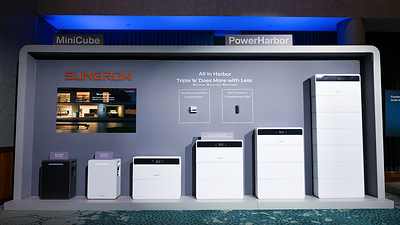
Across the Benelux, the economics of residential solar are entering a new phase. In the Netherlands, the end of the country's net-metering scheme on January 1, 2027, is set to further increase the value of self-consumption. More broadly, dynamic electricity pricing and grid constraints are making flexibility and intelligent energy management more valuable. For households, the question is no longer simply how much electricity they can generate, but when to use it, how to store it and when to feed it back. Against this backdrop, Sungrow presented its portfolio, with PowerHarbor at its core, alongside PowerKeeper for commercial applications and MiniCube for space-constrained homes.
PowerHarbor: Built Around the Needs of the Modern Home
At the event, Sungrow brought PowerHarbor, its latest all-in-one residential ESS, to the Benelux market for the first time. Under the theme "All in Harbor", it brings the inverter, battery, backup and energy management together in one system. Built around the "Triple W" value proposition—Win More, Waste Less, Work Faster—it is designed to help households get more value from their solar energy while taking up less space, requiring fewer additional devices, and enabling faster installation.
Designed for Homeowners: More Value from Every kWh
PowerHarbor supports up to 160% PV-to-battery charging, so the battery can absorb more of the solar generation peak instead of letting it be curtailed or exported at low value. Its 0.66P discharge rate lets the battery respond quickly to changing household demand and to VPP dispatch signals, making stored energy available when it is most valuable. In homes with heat pumps and EV chargers, demand rarely sits evenly across the phases. PowerHarbor supports up to 150% three-phase unbalanced output*, giving households greater flexibility to run high-power appliances when needed while making better use of their own solar energy. In addition, PowerHarbor comes standard with iHomeManager Mini, the industry's first Mini AI solution. With a single tap, homeowners can activate its AI Mode, which analyzes weather forecasts, household consumption patterns and dynamic tariffs to help determine when energy should be stored, held or discharged.
Designed for Installers: Less Time on Site, Simpler Installs
PowerHarbor's modular, plug-and-play architecture allows modules to connect directly without cables, with each blind-mate connection taking around 10 seconds. All external wiring terminals sit on the right-hand side of the unit, making wiring and installation more straightforward. The 5-in-1 EnergyBridge is up to 99% smaller by volume than a conventional gateway, fits inside a standard distribution box and installs in around 20 seconds with no wall damage, while its integrated design reduces external wiring points. At just 25.5 cm deep, PowerHarbor can fit into narrow corridors and passageways. With the plug-in iHomeManager Mini, no separate EMS control box needs to be installed. Learn more about PowerHarbor
PowerKeeper: More Value from the Grid Connection a Business Already Has
Many installers in the Benelux already work across both residential and commercial projects, where the constraint is often not the equipment but the grid connection. Sungrow also showcased PowerKeeper, its modular C&I energy storage series, built around that constraint. Its demand control keeps a site's peak draw inside the connection it already has, while self-consumption and arbitrage run alongside it, helping a business serve more load without waiting for a larger connection. Its modular design lets capacity scale with the site rather than being oversized to a fixed product, and grow as the business does. With projects already deployed in the UK and Italy, PowerKeeper is helping businesses get more out of the grid capacity they have.
MiniCube: A Lower-Barrier Entry Point for Smaller Homes
Rounding out the portfolio, Sungrow also showcased MiniCube for apartments, townhouses and other space-constrained homes—a compact plug-and-play micro storage solution with a power output of 3.68 kW and 5–10 kWh of capacity, offering an accessible way into residential energy storage.
From Market Insight to Real-World Experience
The event also brought market perspectives and field experience into the conversation. Gijs Stevers, market analyst at Equinox Insights, framed stackable storage as a natural step in the market's evolution: "This isn't a new product category. It's where the market has been heading. Two brands in a cupboard, then one brand, then a monoblock, and now stackable systems like PowerHarbor that grow as the household does."
Nick Vriend, Energy Systems Advisor at Zonzo Duurzame Energie, who has already installed PowerHarbor, said: "The bottleneck in the Dutch home battery market is no longer hardware—it's the installer's time. PowerHarbor's unique design cuts that down. That's the right thing at the right time."
"As the Benelux residential energy market moves from maximizing solar generation toward maximizing the value of every kilowatt-hour, Sungrow is building its portfolio around a more integrated model of home energy—connecting generation, storage, consumption, backup and intelligent energy management across solutions designed for different homes and market conditions," said Jerry Zhang, Benelux Country Manager at Sungrow. Backed by two R&D centers, seven warehouses and three training and technology competence centers in Europe, Sungrow will continue to work closely with channel partners, installers and energy innovators across the region to make integrated energy solutions more accessible, flexible and practical for households and businesses.
*Up to 150% three-phase unbalanced output applies to 10–12 kW models.
Contact:
Ava Liu
liuke4@sungrowpower.com
+86 15209833830

 View original content to download multimedia:https://www.prnewswire.co.uk/news-releases/making-every-kilowatt-hour-count-sungrow-brings-its-full-scenario-home-energy-solutions-to-a-changing-benelux-market-302887437.html

Eine Podiumsdiskussion der Wiener FPÖ zum Titel „Der Preis des Klimakommunismus – Wer zahlt die Zeche?“ sorgt in der Stadtpolitik für erheblichen Wirbel. Die Freiheitliche Akademie Wien, das Freiheitliche Bildungsinstitut und der FPÖ-Rathausklub laden am 6. Oktober in die Volkshalle des Wiener Rathauses und holen dafür James Taylor, Präsident des US-amerikanischen Heartland Institute, nach Wien. Taylor gilt seit Jahren als prominenter Akteur der internationalen Szene, die den menschengemachten Klimawandel in Zweifel zieht, und steht seit Langem in der Kritik, weil seine Organisation nachweislich Geld aus der fossilen Industrie erhalten hat.
Auf dem Podium sollen neben Taylor der Wiener FPÖ-Chef Dominik Nepp, Gerald Zmuegg von der Freiheitlichen Wirtschaft Wien sowie der Unternehmer und Politblogger Gerald Markel diskutieren. Eröffnet wird der Abend vom Wiener FPÖ-Klubobmann Maximilian Krauss. Inhaltlich bedient die FPÖ damit ein Narrativ, das sie seit geraumer Zeit in der Klimadebatte verwendet: Klimaschutzmaßnahmen werden als „Klimakommunismus“ adressiert und damit als ideologisch motivierte, wirtschaftlich schädliche Eingriffe gerahmt. Im Zentrum der Veranstaltung steht laut Ankündigung nicht die Abrechnung mit den Kosten der aktuellen Klimaauswirkungen, sondern mit jenen einer ambitionierten Klimapolitik.
Die Einladung Taylors fällt in ein Jahr, das in Europa und Österreich von außergewöhnlichen Wetterextremen geprägt ist. 2026 brachte neue Temperaturrekorde, eine hohe Zahl an Hitzetagen und Tropennächten und eine sich seit dem Frühjahr verschärfende Trockenheit. In der Landwirtschaft werden die Hitzeschäden europaweit auf 14 bis 17 Milliarden Euro geschätzt, für Österreich beziffert die Hagelversicherung den Dürreschaden auf rund 1 Milliarde Euro. Die Agentur für Gesundheit und Ernährungssicherheit (AGES) meldet zudem eine Rekordzahl an Hitzetoten: Im Juni und Juli starben demnach 646 Menschen in Österreich an den Folgen der Hitze. Vor diesem Hintergrund kritisieren Gegner der Veranstaltung, die FPÖ ignoriere die realen Kosten und Risiken der Erderwärmung, während sie über vermeintliche Kosten von Klimapolitik diskutieren lässt.
Wiens Bürgermeister Michael Ludwig (SPÖ) distanzierte sich in einer Stellungnahme deutlich von der inhaltlichen Ausrichtung des Abends. Die Stadt bekenne sich zu den wissenschaftlichen Erkenntnissen über den menschengemachten Klimawandel und zu einer verantwortungsvollen Klimapolitik, betonte er. Positionen, die Klimaschutz pauschal als „Klimakommunismus“ diffamieren, lehne er ausdrücklich ab. Zugleich verwies Ludwig auf die Rolle des Rathauses als „Haus der Demokratie“: Den im Gemeinderat vertretenen Fraktionen stünden grundsätzlich Räumlichkeiten für Veranstaltungen zur Verfügung. Kritik kam auch von den Wiener Grünen, deren Vorsitzender Peter Kraus die Einladung Taylors als „Verhöhnung“ der Bevölkerung bezeichnete, die mit den Folgen von Hitze und Dürre konfrontiert sei, und den Bürgermeister aufforderte, zu prüfen, ob für eine derartige Veranstaltung tatsächlich Räume im Rathaus zur Verfügung gestellt werden sollten.