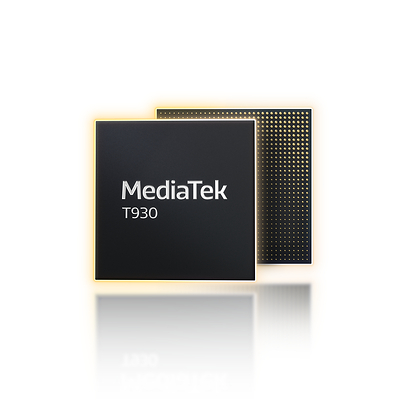
MediaTek T930 modem integrates 8Rx/3Tx, Edge AI and Wi-Fi 8, delivering more than 70% higher uplink throughput and more than 40% higher downlink
HSINCHU, Oct. 7, 2026 /PRNewswire/ -- MediaTek and its subsidiary Airoha Technology are jointly showcasing next-generation fixed and wireless broadband connectivity at Network X 2026. Featuring a comprehensive connectivity portfolio spanning Wi-Fi, 5G CPE and PON, the companies are bringing emerging AI applications and services to home, office and on-the-go users. At the event, MediaTek is showcasing its next-generation Fixed Wireless Access (FWA) platform. Integrating 5G-Advanced connectivity, Edge AI capabilities, and Wi-Fi 8 technology, the solution combines the MediaTek T930 and Filogic 8800 with advanced RF technologies to deliver over 70% increase in uplink throughput and over 40% increase in downlink throughput, maximizing channel utilization. Furthermore, the platform has also been shortlisted for the Network X Awards 2026 "Best FWA Solution of the Year."
Evan Su, Vice President and General Manager of the Wireless Communications Business Unit at MediaTek, said: "In order to further expand FWA market adoption, mobile network capacity, CPE efficiency and the actual in-home connectivity experience must all be improved simultaneously. Through stronger uplink and downlink capabilities and intelligent traffic management, we help telecom operators increase the number of subscribers they can serve and improve network efficiency while controlling network upgrade costs, continuously enhancing the commercial value of FWA. We also work closely with Airoha, fully supporting global telecom customers in playing a critical role in advancing network infrastructure and enabling AI to scale and become broadly accessible."
Enabling AI Applications with High Bidirectional Bandwidth and Ultra-Low Latency
AI, cloud gaming and real-time cloud services continue to raise network access requirements for Gigabit bandwidth and ultra-low latency. For telecom operators, further expanding FWA commercial deployment requires not only higher wireless access performance, but also increased capacity and service quality while keeping core network upgrade costs under control. MediaTek T930 moves more intelligence and performance optimization capabilities to the CPE edge, integrating AI-AQM, the world's first 8Rx 3CC, 3Tx 5L, HPUE PC1 33 dBm and Wi-Fi 8, enabling telecom operators to further enhance FWA service capabilities through CPE innovation.
Through 8Rx 3CC, T930 can improve network downlink throughput by more than 40% while extending network coverage. At the same time, the combination of HPUE PC1 and 3Tx 5L increases transmission power by 5 dB, improving network uplink throughput by more than 70%. The resulting increase in overall capacity can help reduce the cost to serve each household and improve network investment efficiency.
MediaTek AI-AQM (Active Queue Management) brings intelligent queue management to the CPE edge. It's validated AI-AQM technology can provide cloud gaming users with up to a 10x improvement in network latency, enabling operators to further improve user experience for latency-sensitive applications such as cloud gaming without requiring major changes to the core network.
Exhibition: MediaTek + Airoha @ Booth K35
Network X 2026: 13-15 October 2026 @ Messe Wien, Vienna, Austria
 View original content to download multimedia:https://www.prnewswire.co.uk/news-releases/mediatek-demos-5g-advanced-fwa-platform-at-network-x-2026-302900741.html

Der bewaffnete Juwelenraub im Wiener Museum für angewandte Kunst (MAK) vom 27. August ist nach Einschätzung externer Fachleute nicht auf Versäumnisse der Institution zurückzuführen. Ein 34 Seiten umfassendes Gutachten des Sicherheitsconsulting-Unternehmens LifeLine's kommt zu dem Schluss, dass das Haus sowohl bei den technischen Sicherheitsvorkehrungen als auch beim operativen Vorgehen während des Überfalls und im anschließenden Krisenmanagement korrekt gehandelt hat. Die zentrale Frage, ob das Ereignis sicherheitstechnisch und organisatorisch adäquat bewältigt wurde, beantworten die Gutachter mit einem „klaren Ja“.
Im Fokus der Untersuchung stand die Ausstellung „Glanzstücke. Van Cleef & Arpels High Jewelry x Masterpieces from the MAK Collection“, in deren Juwelenraum zwei bewaffnete Täter mitten am Nachmittag eine Vitrine einschlugen und mit einem historischen Diamantcollier flüchteten. Laut Bericht waren alle mit den Vertragspartnern vereinbarten Sicherheitsstandards und Normen erfüllt. Dazu zählten unter anderem der Einsatz von 185 Videokameras, einer dreistelligen Zahl von Alarmsensoren, speziellem Sicherheitsglas sowie geschultem Sicherheitspersonal. Der nach der Tat eingeführte Einsatz von Metalldetektoren war laut Gutachten zuvor weder verlangt noch durch bestehende Standards vorgesehen.
Besonders hervor hebt der Bericht die bewusste Entscheidung für den Vorrang des Personenschutzes vor dem Objektschutz. Aus diesem Grund verzichtete das Museum auf laute Alarmsignale während der Öffnungszeiten und auf bewaffnete Sicherheitskräfte im Ausstellungsbereich. Die direkte Alarmierung von Polizei und hauseigener Sicherheitszentrale wurde den Angaben zufolge um 14:01:22 Uhr ausgelöst und habe „optimal und effizient“ funktioniert. Auch das Verhalten der anwesenden Securitas-Mitarbeitenden wird positiv bewertet: Sie hätten eine unmittelbare Konfrontation mit den bewaffneten Tätern und damit das Risiko einer Eskalation, etwa durch Panik oder mögliche Geiselnahmen, vermieden.
Die Gutachter kommen insgesamt zu dem Befund, dass ein von professionellen Tätern geplanter und durchgeführter Raub unter regulären Öffnungsbedingungen mit „vernünftigen Mitteln“ nicht vollständig zu verhindern gewesen sei – selbst bei Einsatz moderner Überwachungstechnik und etablierter Sicherheitsprotokolle. Aus ihrer Sicht bestätigt der Fall eine bekannte Grenze musealer Schutzkonzepte: Absolute Sicherheit wäre nur um den Preis massiver Einschränkungen der Bewegungsfreiheit von Besucherinnen und Besuchern zu erreichen, formuliert das Gutachten sinngemäß. Das MAK wird damit für den konkreten Vorfall entlastet, auch wenn der spektakuläre Coup die Debatte über Sicherheitsstandards in Ausstellungshäusern neu anheizen dürfte.