Publicly playable at mora.fun, Mora combines coding agents, 3D generation and real-time video; Meshy also introduces finer geometric detail with Meshy 7.1
SILICON VALLEY, Calif., Sept. 21, 2026 /PRNewswire/ -- Meshy, the AI-powered 3D generation platform, recently detailed Mora (Multimodal Open-world Real-time Architecture), its answer to one of the most ambitious goals in AI: generating complete worlds that people can explore, play and interact with in real time. Mora 1, an early demonstration available at mora.fun, features playable experiences ranging from spatial puzzles and multiplayer platforming to building, racing and sports, with switchable visual styles.
Much of the industry has approached this goal by asking a single video model to simulate an entire world end to end — an approach that continues to struggle with consistent spaces and complex interaction. Mora is built on a different conviction: a world should be constructed, and only then rendered. The architecture assigns each part of world generation to the layer best equipped for it: coding agents write the logic and mechanics that make a world run; Meshy's 3D generation builds its spatial structure and assets; and a real-time video model turns that structure into final imagery and audio.
The result is a foundation on which game rules hold, spaces persist, and visual quality rises with every generation of video models. Because the layers advance independently, progress anywhere in AI — stronger coding agents, richer 3D generation, faster video models — compounds inside Mora.
For creators, the longer-term opportunity is to bring the elements of an interactive world into a more connected creative process. A change to how a game works could be developed alongside changes to how it looks, with agents helping to build and refine both. Because Mora separates these functions, advances in coding agents, 3D generation and video models can contribute to the architecture's development individually.
Mora 1 is an early research demonstration focused on validating this architecture. Its public demos let visitors experience the approach through gameplay; a general-purpose world creation tool is a longer-term goal. Development of Mora 2 is underway as Meshy continues its research into richer AI-generated interactive experiences.
Meshy 7.1: the first generative 3D model to reach 4096³ geometric resolution
Alongside its research into interactive worlds, Meshy continues to advance the 3D generation models at the core of its platform. On September 16, the company launched Meshy 7.1, the new version of its flagship image-to-3D model, now available to all registered users. Meshy 7.1 introduces two high-detail generation modes, Ultra 2K and Ultra 4K.
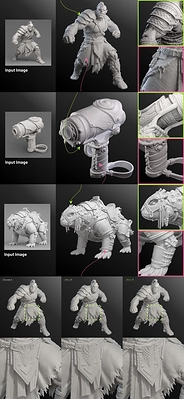
At its Ultra 4K setting, Meshy 7.1 generates geometry at 4096³ voxel resolution, with raw meshes reaching up to 80 million triangles before simplification. This makes Meshy 7.1 the first generative 3D model to reach 4096³ geometric resolution. Fine features such as stitching, woven fabric and individual scales can be generated as part of the mesh itself. These geometric details matter in workflows such as 3D printing and digital sculpting, where surface structure must be carried by the model.
In internal evaluations using Meshy's newly developed Detail Richness Benchmark, Meshy 7.1 ranked first among five tested image-to-3D models across all three evaluated rendering resolutions. The benchmark measures geometric surface detail, providing a focused assessment of this aspect of model quality. Methodology and results are available in Meshy's technical report, and the company plans to release the benchmark as a standalone tool.
Ultra 2K and Ultra 4K modes, along with downloads of models generated by Meshy 7.1, require a paid subscription. Ultra 2K supports single-view and multi-view generation; Ultra 4K currently supports single-view generation.
FAQ:
Mora (Multimodal Open-world Real-time Architecture) is a research architecture developed by Meshy for creating AI-generated interactive worlds that people can explore, play and interact with in real time. Mora 1 is an early, publicly playable research demonstration, while a general-purpose world creation tool remains a longer-term goal. Development of Mora 2 is underway as Meshy continues its research into richer AI-generated interactive experiences.
Mora assigns different parts of world generation to specialized layers. Coding agents generate game logic and mechanics, Meshy's 3D generation provides assets and spatial structure, and a real-time video model generates the final imagery and audio.
The architecture gives game rules and spatial relationships an explicit foundation in code and 3D graphics, allowing the video model to focus on visual presentation. The approach is designed to address challenges in maintaining consistent spaces and supporting complex interactions.
Mora 1's playable research demonstrations are available at mora.fun. Current experiences include spatial puzzles, multiplayer platforming, building, racing and sports, with switchable visual styles.
Ultra 4K is one of two high-detail generation modes introduced in Meshy 7.1, alongside Ultra 2K. It generates geometry at 4096³ voxel resolution, the highest setting available, so fine features such as stitching, woven fabric and individual scales are built into the mesh itself rather than painted on as textures. Ultra 4K currently supports single-view generation and requires a paid subscription.
About Meshy
Meshy builds foundation models for AI-powered 3D generation, helping people turn text and images into 3D assets for games, film, design and 3D printing. Founded by Ethan Hu, who holds a Ph.D. from MIT, Meshy serves more than 12 million registered users worldwide. In July 2026, the company announced nearly $400 million in Series B funding at a $1.5 billion valuation. Learn more at meshy.ai.
 View original content to download multimedia:https://www.prnewswire.co.uk/news-releases/meshy-details-mora-a-research-architecture-for-ai-generated-interactive-worlds-and-launches-meshy-7-1--302884874.html

Mercedes-Benz verzeichnet ein zunehmend zweigeteiltes Bild seiner weltweiten Fahrzeugverkäufe. Während die Konzernzahlen im dritten Quartal 2026 global rückläufig waren, meldet die Indien-Tochter ein Rekordquartal. In Indien setzte Mercedes-Benz im Zeitraum Juli bis September 5.422 Fahrzeuge ab, ein Plus von 6 Prozent gegenüber dem Vorjahr und zugleich der beste Quartalswert in der Geschichte des Unternehmens im Land. Von Januar bis September summierten sich die Verkäufe dort auf 15.190 Einheiten, rund 8 Prozent mehr als im entsprechenden Vorjahreszeitraum.
Auf Konzernebene dagegen schrumpften die Auslieferungen im gleichen Quartal. Weltweit setzte Mercedes-Benz 491.700 Pkw und leichte Nutzfahrzeuge ab, ein Minus von 6 Prozent im Vergleich zum Vorjahr. Im Pkw-Geschäft allein sanken die globalen Verkäufe um 8 Prozent auf 407.200 Einheiten. Besonders belastend wirkte die Entwicklung in Asien und hier vor allem in China: In der Volksrepublik gingen die Pkw-Verkäufe um knapp ein Drittel auf 86.800 Fahrzeuge zurück, konzernweit meldete der Hersteller für Asien ein Minus von 25 Prozent auf 132.300 Autos. Ein Zuwachs in Europa und Nordamerika reichte nicht aus, um die Schwäche in China zu kompensieren.
Kontrastreich präsentiert sich auch das Bild in den oberen Preissegmenten. In Indien trugen Top-End-Luxusmodelle – darunter S‑Klasse, Mercedes‑Maybach, EQS Maybach SUV, G‑Klasse, V‑Klasse und AMG‑Modelle – maßgeblich zum Wachstum bei: Diese Klasse legte dort im Jahresvergleich um mehr als 13 Prozent zu und kam auf über ein Viertel des Gesamtabsatzes. Innerhalb dieses Segments nutzten laut Unternehmen fast drei Viertel der Kunden das MANUFAKTUR‑Personalisierungsprogramm. Die Performance-Marke AMG steigerte ihre Auslieferungen in Indien um mehr als 18 Prozent, das AMG G 63 erzielte den höchsten monatlichen Absatz seit Markteinführung. Global hingegen verzeichnete Mercedes-Benz im teuersten Segment aus S‑Klasse, Maybach und AMG ein deutliches Minus von gut 20 Prozent im dritten Quartal.
Stärker als die Verbrenner legten weltweit die batterieelektrischen Modelle zu. Vertriebs- und Marketingvorstand Mathias Geisen sprach von dem höchsten Quartalsabsatz vollelektrischer Pkw in der Unternehmensgeschichte; in Europa war nahezu jedes dritte verkaufte Auto rein elektrisch. Der elektrische GLC trug dabei überproportional zum Wachstum bei und vervielfachte seine Verkäufe gegenüber dem zweiten Quartal. In Indien setzt der Konzern seinen Fokus ebenfalls auf Elektrifizierung: Dort stehen die Markteinführung einer elektrifizierten S‑Klasse mit Auslieferungsstart Mitte Oktober sowie die Premiere des GLC BEV Anfang November an, die das Portfolio am Subkontinent weiter ausbauen sollen.
Die Transportersparte Vans erwies sich zuletzt als Stabilitätsanker. Mit einem Plus von 1 Prozent auf 84.400 Fahrzeuge hielt sich das Segment im dritten Quartal nahezu auf Vorjahresniveau. Insgesamt aber bleibt der Druck auf das Kerngeschäft hoch, da der Wettbewerb im wichtigen Markt China nach Konzernangaben intensiv und das Umfeld weiterhin schwierig ist. In dem Land gehören der GLC und die E‑Klasse zu den meistverkauften Baureihen des Herstellers und machen dort fast zwei Drittel der Pkw-Verkäufe aus. Die anhaltende Schwäche in China, die bereits im zweiten Quartal mit einem Absatzminus von rund 30 Prozent sichtbar war, unterstreicht für Mercedes-Benz die Bedeutung eines breiter diversifizierten Wachstums – mit Märkten wie Indien, in denen das Premium- und Luxusgeschäft derzeit gegensätzlich zum Trend zulegt.