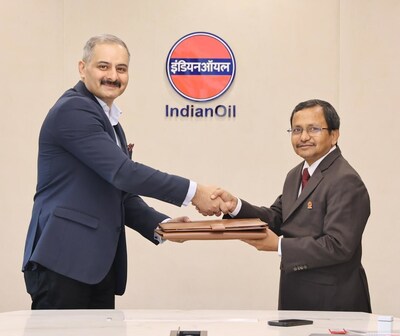
MUMBAI, India, March 13, 2026 /PRNewswire/ -- Re Sustainability has signed an exclusive MoU with Indian Oil Corporation Limited to launch India's first structured national initiative for the collection and recycling of used lubricating oil. The initiative will enable systematic recovery and re-refining of used lubricants, reducing reliance on virgin crude-derived base oils while conserving resources and lowering foreign exchange outflows.
The collaboration will establish a dedicated SPV to build a nationwide reverse logistics and collection network for used lubricating oil. The platform will aggregate lubricants from industrial and automotive sectors and develop Re-Refined Base Oil (RRBO) infrastructure to produce Group I and Group II+ base oils in partnership with Re Sustainability and its technology partners.
Mr. Bankim Patra, Country Head (Lubes), Indian Oil Corporation Limited:
"As India's largest integrated energy company, Indian Oil is committed to advancing solutions that strengthen energy security and environmental responsibility. This collaboration supports the creation of sustainable value chains for responsible recovery, reuse, and circular utilisation of lubricants."
Recovered oil will be processed into Re-Refined Base Oil (RRBO) and reintroduced into lubricant manufacturing. This circular approach reduces reliance on virgin crude-derived base oils and improves resource efficiency across the sector.
Mr. Masood Mallick, Managing Director & Group CEO, Re Sustainability Limited:
"India's journey towards a circular economy requires large-scale systems that can recover value from complex waste streams and reintegrate them into productive use. Our partnership with Indian Oil marks a transformative step towards institutionalising oil recycling at industrial scale in India. By building an integrated ecosystem for used lubricant recovery and re-refining, we are enabling the transition from waste management to resource recovery while strengthening India's environmental infrastructure and circular economy."
The partnership targets an annual collection of 100 KTA of used lubricating oil through a nationwide network of aggregation, logistics, and traceability systems. The initiative will also establish a re-refining facility with a capacity of 50 to 100 KTA of Group II+ RRBO.
It will additionally include recovery and recycling of plastic lubricant containers in line with Extended Producer Responsibility (EPR) regulations.
India generates about 1.3 million tonnes of used lubricating oil annually, but only around 0.2 million tonnes is recovered through formal recycling. This initiative aims to expand formal recovery infrastructure, unlock the value of used lubricants, and support India's transition toward a circular and resource-efficient economy.
Photo: https://mma.prnewswire.com/media/2933434/Re_Sustainability_IOCL_MoU.jpg
Logo: https://mma.prnewswire.com/media/2933433/Re_Sustainability_Logo.jpg
Logo: https://mma.prnewswire.com/media/2933432/IndianOil_Logo.jpg
 View original content:https://www.prnewswire.co.uk/news-releases/re-sustainability-and-indian-oil-join-hands-to-create-indias-first-integrated-used-oil-circular-economy-ecosystem-302713402.html


Österreichs Städtetourismus hat 2025 kräftig zugelegt und sich einmal mehr als wichtiger Wachstumsmotor für den Gesamttourismus erwiesen. In den neun Hauptstädten wurden im vergangenen Jahr 29,1 Millionen Nächtigungen gezählt, ein Plus von 6 Prozent gegenüber 2024. Damit entfällt rund ein Fünftel beziehungsweise 18 Prozent des gesamten Tourismusvolumens des Landes auf Wien und die acht Landeshauptstädte. Die Zahl der Ankünfte in den Städten stieg um 5 Prozent auf knapp 13,55 Millionen.
Wien behauptete seine dominante Rolle klar: Mit knapp 20,1 Millionen Übernachtungen verbuchte die Bundeshauptstadt ein Nächtigungsplus von 7 Prozent und kommt damit auf rund zwei Drittel aller Hauptstadt-Nächtigungen. Deutlich dahinter folgen Salzburg mit 3,3 Millionen Nächtigungen (plus 5 Prozent) und Innsbruck mit knapp 2 Millionen (plus 4 Prozent). Graz erreichte 1,5 Millionen Übernachtungen (plus 5 Prozent), Linz gut 1 Million (plus 1 Prozent). In der zweiten Reihe der Städtedestinationen legten Klagenfurt (514.501 Nächtigungen, plus 3 Prozent), Bregenz (386.669, plus 1 Prozent) und St. Pölten (238.336, plus 3 Prozent) zu. Schlusslicht bleibt Eisenstadt mit 69.902 Nächtigungen, verzeichnet aber mit 11 Prozent den stärksten relativen Zuwachs.
Insgesamt wurden im österreichischen Tourismus 2025 rund 157,3 Millionen Nächtigungen registriert, ein Zuwachs von 2 Prozent im Jahresabstand. Ohne die Städte hätte das Plus laut WienTourismus lediglich 1 Prozent betragen. Der starke Beitrag der urbanen Zentren zeigt sich damit nicht nur in absoluten Zahlen, sondern auch im überdurchschnittlichen Wachstum gegenüber dem Bundesdurchschnitt. WienTourismus-Geschäftsführer Norbert Kettner, zugleich Vorsitzender der Arbeitsgemeinschaft Städtetourismus (ARGE Städte), spricht von einem „zentralen Wachstumstreiber“ des österreichischen Gesamttourismus.
Der Städtetourismus ist stark von Kunst und Kultur geprägt und gilt als Ganzjahresprodukt. Laut Kettner sorgt er für standortgebundene Arbeitsplätze und wirkt über Spillover-Effekte in andere Branchen hinein, etwa in den Handel. Weil die Nachfrage sich nicht auf einzelne Saisonen konzentriert, entstehen Ganzjahresjobs – ein Argument, das vor dem Hintergrund des Arbeitskräftemangels in der Branche zunehmend an Gewicht gewinnt. Die aktuellen Kennzahlen unterstreichen damit die Rolle der Städte als wirtschaftliche Stütze weit über Hotellerie und Gastronomie hinaus.