EDINA, Minn., Sept. 15, 2026 /PRNewswire/ -- ReEmerge, Inc. (ReEmerge), a private MedTech company innovating a new way to address cognitive impairment, launched from stealth today following the close of an oversubscribed $37M Series A financing. The proceeds will support an upcoming clinical study that will evaluate ReEmerge's proprietary Cognitive Network Restoration Therapy (CNRT) in its first clinical indication, traumatic brain injury (TBI), while advancing technology development, expanding clinical and regulatory operations, and preparing the platform for future indications. U.S. Venture Partners (USVP) and Santé co-led the round, with significant participation from Oxford Science Enterprises, 415 Capital, IAG Capital Partners, The Vertical Group, and Dendrion Ventures.
"ReEmerge's technology represents a fundamentally different approach to cognitive recovery with the potential to transform the recovery pathway," commented Jonathan Root, MD, General Partner at USVP. "The size of the opportunity and the profound unmet need make this an especially compelling market for innovation. We are excited about this technology and the new hope it aims to offer patients and their families."
"TBI does not discriminate. It can happen to anyone at any age, and its consequences can fundamentally alter a person's ability to live, work, and engage with the world around them," said Auriel August, MD, Principal at Santé. "CNRT could offer people living with TBI something they have too often been told not to expect, namely the possibility of meaningful cognitive recovery."
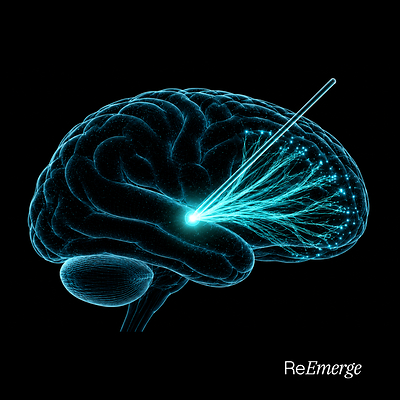
CNRT is a proprietary, first-of-its-kind approach that precisely targets neural networks in the central thalamus, a brain hub involved in attention, arousal, and executive function. Rather than bypassing damaged pathways or asking patients to compensate for lost function, CNRT aims to augment the recovery journey by driving underactive but viable neural circuits. By restoring function across existing but underperforming networks, CNRT aims to reverse cognitive deficits and allow recovery to extend further.
This technology grew out of decades of research by Nicholas Schiff, M.D. Professor of Neuroscience in the Feil Family Brain and Mind Research Institute at Weill Cornell Medicine and colleagues at Stanford University and the University of Utah, which explored the possible restorative effect of brain electrical stimulation after TBI. A pilot study showed promising results, with patients regaining cognitive function. The Center for Technology Licensing at Weill Cornell worked closely with Dr. Schiff's team to protect the intellectual property, provide internal translational gap funding, and license the foundational intellectual property to ReEmerge to advance clinical and commercial development of CNRT.
Building upon this groundbreaking clinical research, including a publication in Nature Medicine, ReEmerge will conduct a prospective, single-arm, multicenter study (NCT07730099) to evaluate this treatment, enrolling up to 40 patients with chronic moderate-to-severe TBI. Additionally, the study will explore potential effects on cognitive and functional outcomes.
"As a physician-scientist and co-founder, it has been very rewarding to see the arc of benchtop science moving forward and being translated into a meaningful clinical development pathway," stated Dr. Schiff. "I am excited for us to advance the testing of treatment for many patients, who have historically had limited therapeutic options, as we look to shift cognitive care from rehabilitation to restoration and ultimately, to redefine recovery."
Each year, an estimated 27 million people worldwide experience a traumatic brain injury, and many are left with persistent cognitive impairment.1 Current recovery pathways focus on rehabilitation, helping patients compensate for cognitive deficits through structured routines, adaptive strategies, and supportive therapies. While these interventions can improve function, the journey can be long, and recovery will often plateau, frequently leaving patients with lasting impairments that limit independence, quality of life, and personhood.
"The strong support of our stellar investor syndicate validates our mission to evolve the recovery trajectory for patients living with impaired cognitive function," said Todd Langevin, Chief Executive Officer of ReEmerge. "We look forward to initiating our clinical study in TBI and building a robust body of evidence to support our differentiated approach to treating cognitive impairment."
About ReEmerge, Inc.
ReEmerge is innovating a new way to approach chronic cognitive impairment. Developed under an exclusive licensing agreement with Cornell University, the company's novel Cognitive Network Restoration Therapy (CNRT) precisely targets neural networks disrupted by brain injury that drive underactive but viable neural circuits. By restoring function across these existing but underperforming networks, CNRT aims to reverse cognitive deficits and restore agency and personhood. To learn more about how the company is developing therapeutic innovations that evolve cognitive care from rehabilitation to restoration, please visit ReEmergeInc.com.
Media Contact
Charlene Herndon
SPRIG Consulting
charlene@sprigconsuting.com
1Guan B, Anderson DB, Chen L, et al. Global, regional and national burden of traumatic brain injury and spinal cord injury, 1990–2019: a systematic analysis for the Global Burden of Disease Study 2019
BMJ Open 2023;13:e075049. doi: 10.1136/bmjopen-2023-075049
 View original content to download multimedia:https://www.prnewswire.co.uk/news-releases/reemerge-inc-exits-stealth-with-oversubscribed-37m-series-a-to-challenge-the-limitations-of-chronic-cognitive-impairment-caused-by-brain-injuries-302878979.html

Die steirische FPÖ hat ihren traditionellen Frühschoppen beim Hartberger Oktoberfest erneut für eine machtbewusste politische Inszenierung genutzt. Vor rund 3.500 Besucherinnen und Besuchern im vollen Festzelt trat zuerst die Landesführung um Landeshauptmann Mario Kunasek auf, ehe Bundesparteichef Herbert Kickl als Hauptredner die Bühne übernahm. Begleitet von österreichischen Fahnen, „Herbert“-Sprechchören und Schlagern wie Tina Turners „The Best“ präsentierten sich die Freiheitlichen als geschlossene Kraft mit bundespolitischem Anspruch.
Kunasek, der sich nach zuletzt guten Umfragewerten demonstrativ gelöst gab, lobte die Zusammenarbeit mit dem Koalitionspartner ÖVP in der Steiermark. Man streite nicht, sondern es gebe „Arbeit, Arbeit, Arbeit und es funktioniert“, sagte der Landeshauptmann und verwies darauf, dass die „heilige Ordnung“ nach der Landtagswahl 2024 nicht mehr gegolten habe. Zugleich zeichnete er ein scharfes Bild in der Migrations- und Integrationspolitik, warnte vor einer Gefahr durch den „politischen Islam“ und erklärte, für Menschen, die mit „unseren Werten“ ein Problem hätten, müsse es heißen: „Ab, gute Reise.“ Sein Ziel formulierte er klar: Man könne nicht nur den Landeshauptmann stellen, sondern „Österreich auf Vordermann bringen“.
Kickl knüpfte an diese Steilvorlage an und nutzte den Auftritt, um sowohl die eigene Anhängerschaft zu mobilisieren als auch die Konkurrenz frontal anzugreifen. Die „wirkliche Volkspartei“ sei im Zelt versammelt, erklärte er und spielte sich gleichzeitig als von Gegnern unterschätzter, aber entschlossener Politiker in Szene. Er verwies darauf, dass er vielfach als „gefährlichster Politiker“ bezeichnet werde, stellte jedoch klar, gefährlich sei er aus seiner Sicht nicht für „meine Landsleute“, sondern für jene, „die unseren Wohlstand verludern und unsere Heimat stehlen“. Inhaltlich bekräftigte er dabei einmal mehr den Begriff „Remigration“ als eine seiner Visionen für ein künftiges Österreich.
Breiten Raum nahm in Kickls Rede die aktuelle Krise der SPÖ ein, die er als Chance für seine Partei deutete. Die Sozialdemokratie bezeichnete er polemisch als „Selbsthilfegruppe namens Soziademokratie“ und kommentierte die Diskussion um die Nachfolge von Bundesparteichef Andreas Babler mit der Ansage „game over, das Spiel ist vorbei“. Innerhalb der SPÖ würden „Kommunisten mit Kapitalisten streiten, wer die besseren Sozialisten sind“, sagte Kickl mit Blick auf innerparteiliche Flügelkonflikte und Ambitionen potenzieller Kandidaten. Für die kommende Nationalratswahl, die er als „Schicksalswahl“ charakterisierte, gab er sich siegessicher: Wenn sich die Freiheitlichen nicht „auseinanderdividieren lassen“, werde am Ende ein „Volkskanzler“ stehen. Neuwahlen könnten seiner Einschätzung nach „jederzeit daherkommen“, die steirische FPÖ um Kunasek präsentierte er als Vorbild für die Partei in anderen Bundesländern.