CLARK, N.J., June 10, 2026 /PRNewswire/ -- GEP Global Supply Chain Volatility Index, based on a monthly survey of 27,000 businesses, signaled continued pressure on global supply chains in May as manufacturers increased purchases and built safety stocks to protect against rising inflation.

Reports of safety stockpiling rose to their highest level since January 2023, as companies bulk ordered goods and raw materials ahead of expected price increases and potential supply disruption. This front-loaded purchasing pushed global demand for inputs to its strongest since March 2022.
Shortages also worsened in May, reaching their highest level in three-and-a-half years. Combined with elevated transportation costs, the data shows that supply chain pressures are no longer limited to shipping and energy markets.
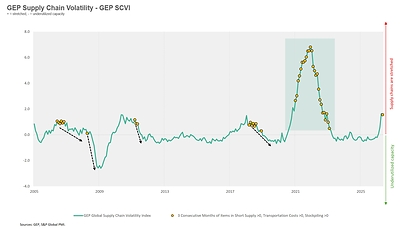
May's data also points to a rare pattern: for three consecutive months, stockpiling, shortages and transportation costs have all been elevated. Outside the 2021-23 supply chain crisis, this has typically been followed by a sharp fall in the index as supply chains self-correct (see chart below), often through weaker input demand or deteriorating economic conditions.
"The path for inflation is already being set, and companies are trying to limit the damage," said John Piatek, vice president, consulting, GEP. "The surge in purchasing we saw in April and May is likely temporary. Once companies have built inventory, they and their customers will pull back, which means supply chain pressures may ease. But, even if the Strait of Hormuz is opened fully, economic conditions will likely weaken in the second half of the year as companies will pull back on their input purchasing to draw down the inventories they've built up."
Interpreting the data:
Index > 0, supply chain capacity is being stretched. The further above 0, the more stretched supply chains are.
Index < 0, supply chain capacity is being underutilized. The further below 0, the more underutilized supply chains are.
MAY 2026 REGIONAL KEY FINDINGS
MAY 2026 KEY FINDINGS
For more information, visit www.gep.com/volatility.
Note: Full historical data dating back to January 2005 is available for subscription. Please contact economics@spglobal.com.
The next release of the GEP Global Supply Chain Volatility Index will be 8 a.m. ET, JuL. 13, 2026.
About the GEP Global Supply Chain Volatility Index
The GEP Global Supply Chain Volatility Index is produced by S&P Global and GEP. It is derived from S&P Global's PMI® surveys, sent to companies in over 40 countries, totaling around 27,000 companies. The headline figure is a weighted sum of six sub-indices derived from PMI data, PMI Comments Trackers and PMI Commodity Price & Supply Indicators compiled by S&P Global.
A Supply Chain Volatility Index is also published at a regional level for Europe, Asia, North America and the U.K. For more information about the methodology, click here.
Media Contacts
Derek Creevey | Joe Hayes | S&P Global Market Intelligence | |
Director, Public Relations | Principal Economist | Corporate Communications | |
GEP | S&P Global Market Intelligence | Email: Press.mi@spglobal.com | |
Phone: +1 646-276-4579 | Phone: +44-1344-328-099 | ||
Email: derek.creevey@gep.com | Email: joe.hayes@spglobal.com |

 View original content to download multimedia:https://www.prnewswire.co.uk/news-releases/safety-stockpiling-hits-highest-level-in-over-three-years-as-businesses-rush-to-protect-against-inflation-and-shortages-gep-global-supply-chain-volatility-index-302794584.html

Bei der Verleihung des BRICK AWARD 26 in Wien hat ein vietnamesisches Projekt den Ton für die internationale Ziegelarchitektur vorgegeben: Der Đạo Mẫu-Tempel mit angeschlossenem Museum wurde mit dem Grand Prize ausgezeichnet. Das Gebäude, das laut Veranstalter CO2-negativ errichtet wurde, setzt auf lokale Tonziegel und gilt als besonders ressourcenschonend. Die Gala in der österreichischen Hauptstadt zeigte, wie weit das Spektrum zeitgenössischer Keramikarchitektur inzwischen reicht – von religiösen Stätten in Asien bis zu Industrieanlagen in Lateinamerika.
Der BRICK AWARD wird seit 2004 alle zwei Jahre vergeben und versteht sich als herstellerunabhängige Plattform für Architekturbüros, die mit Ziegeln und Keramik arbeiten. Ausrichter ist der Baustoffkonzern Wienerberger, der mit dem Preis ein internationales Netzwerk von Pionieren der Ziegelarchitektur bündelt. Prämiert wird in fünf Kategorien: „Feeling at home“ für Einfamilienhäuser und kleinere Projekte, „Living together“ für städtische Wohnanlagen, „Working together“ für Gewerbe- und Industriebauten, „Sharing public spaces“ für öffentliche Gebäude und Räume sowie „Building outside the box“ für besonders innovative Ansätze.
Auf der Ebene der Einzelkategorien spiegelten die diesjährigen Gewinner zentrale Branchentrends wider. In der Kategorie „Feeling at home“ wurde ein offenes Einfamilienhaus auf Mallorca ausgezeichnet, das mithilfe speziell gesetzter Wände den Meerblick maximiert und zugleich Privatsphäre schafft. „Living together“ entschied ein gemischt genutztes Gebäude in Barcelona für sich, das nachhaltige Ziegel mit einem sozialen Innenhof kombiniert und damit auf dichte, aber gemeinschaftlich orientierte Stadtentwicklung setzt. In „Working together“ ging die Auszeichnung an ein Lager- und Bürogebäude in Mexiko, das lokale Keramik und vulkanisches Material integriert und so industrielle Nutzung und regionale Baustoffe verbindet.
Erstmals vergab die Jury zusätzlich einen Sonderpreis für innovatives gemeinschaftliches Wohnen. Dieser ging an ein Projekt in Belgien, das wiederverwendete Ziegel einsetzt, um eine nachhaltige Nachbarschaft zu schaffen. Der Fokus auf Recycling, CO2-Reduktion und lokale Materialien zieht sich damit durch zentrale Gewinnerprojekte des BRICK AWARD 26. Für Wienerberger, dessen Aktie zum Zeitpunkt der Meldung bei 22,71 Euro notierte, schärft die Auszeichnung zugleich das Profil als global vernetzter Akteur im Bereich Ziegel- und Keramiklösungen – mit dem nächsten Termin im Finanzkalender, der Quartalsmitteilung am 12. August 2026, bereits in Sichtweite.