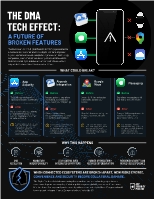
WASHINGTON, July 17, 2026 /PRNewswire/ -- On Wednesday, the European Commission issued two binding orders under the Digital Markets Act requiring Google to make its Android and Search platforms more accessible to competitors. The measures require Google to let third-party artificial intelligence (AI) assistants access key Android features on equal terms with Google's AI products and to share sensitive Google Search data with rival search engines and AI-powered search services.
In response to the EC's announcement, David B. McGarry, Research Director of the Taxpayers Protection Alliance, offered the following statement:
"The European Commission has issued a warning: Do not succeed. If technology companies innovate too effectively or if their products are markedly superior to their competitors', regulators will come calling. Google, having innovated tirelessly and maintained a legitimate competitive advantage for years, has been told that it must give over sensitive information about itself and its operations to prop up rivals. Intellectual property and trade secrets mean shockingly little to European Union bureaucrats.
"But, as they say, it's worse than that: the EC will require Google to share sensitive search data with its competitors, data which users entrusted to Google with the confidence that it would remain private. And, adding, another layer of folly, these data are likely to be sent not only to European tech companies—itself a violation—but to companies under the sway of the West's geopolitical rivals, such as China. Short-sighted attempts to establish faux competition are one thing, endangering the national security of America and her allies is another. These dangers will not only haunt Europeans but Americans passing through, or residing in, the European Union, including government and military personnel.
"The continent is edging ever closer to a crisis point. Eventually, its heavy-handed rules will, in fact, break the internet as it now exists, at least for European users. Having smothered its own technologists, the Europeans are driving away American technology companies.
"If the Europeans lack the will or ability to correct course—as seems to be the case—American policymakers, especially those in the Trump administration, ought to exert maximal diplomatic pressure to protect the interests of American tech companies, American users, and American national security."
The Taxpayers Protection Alliance (TPA) is a non-profit, non-partisan organization dedicated to educating the public through the research, analysis, and dissemination of information on the government's impact on the economy.
 View original content to download multimedia:https://www.prnewswire.co.uk/news-releases/taxpayer-watchdog-slams-eus-latest-tech-overreach-302828211.html

Die österreichische Steyr Motors AG baut ihr Geschäft im Bereich autonomer Verteidigungs- und Sicherheitssysteme aus und setzt damit auf einen der am schnellsten wachsenden Segmente der Rüstungsindustrie. Nach bereits realisierten Anwendungen in unbemannten Überwasserfahrzeugen (USV) kommen die Hochleistungsmotoren des Unternehmens nun auch in modernen unbemannten Bodenfahrzeugen (Unmanned Ground Vehicles, UGV) zum Einsatz. Im Zentrum steht dabei die Plattform CORNUS des slowenischen Spezialisten RTC, die künftig mit Antriebstechnologie von Steyr Motors ausgestattet wird.
Das CORNUS-UGV ist als modulare Plattform für anspruchsvolle Einsätze in militärischen und sicherheitsrelevanten Umgebungen ausgelegt. Es lässt sich flexibel für unterschiedliche Missionen konfigurieren, darunter Aufklärungsaufgaben, Logistiktransporte in schwierigem Gelände, die mobile Energieversorgung im Feld sowie die unmittelbare Unterstützung von Einsatzkräften. In all diesen Anwendungen sind Zuverlässigkeit, Robustheit und Ausfallsicherheit zentrale Anforderungen – Bereiche, in denen Steyr Motors auf jahrzehntelange Erfahrung aus Marine-, Spezialfahrzeug- und Defense-Anwendungen verweist.
Der Schritt in den UGV-Markt erfolgt vor dem Hintergrund eines breiten Trends hin zu autonomen und unbemannten Systemen. Weltweit investieren Streitkräfte verstärkt in autonome Aufklärungsplattformen, unbemannte Logistikfahrzeuge, ferngesteuerte Schutzsysteme und maritime Robotik, um Risiken für Soldaten zu verringern und gleichzeitig die operative Leistungsfähigkeit zu erhöhen. Ein jüngstes Beispiel für die wachsende Bedeutung solcher Technologien ist eine US-Rettungsaktion in der Straße von Hormus, bei der unbemannte Überwasserfahrzeuge zum Einsatz kamen und damit die Relevanz autonomer Fahrzeugplattformen unterstrichen haben.
Branchenanalysen veranschlagen das Volumen des globalen Marktes für unbemannte Systeme bis zum Jahr 2033 auf mehr als 67 Milliarden US-Dollar. Steyr Motors sieht sich als Technologiezulieferer gut positioniert, um von dieser Entwicklung zu profitieren. Das Unternehmen betont, dass das Wachstumspotenzial aus autonomen Defense-Lösungen im aktuellen Auftragsbestand erst in Ansätzen abgebildet ist. Der Einstieg in das CORNUS-Programm gilt vor diesem Hintergrund als weiterer Baustein, um die Präsenz im Zukunftsmarkt unbemannter Systeme deutlich auszubauen.