HONG KONG, Aug. 28, 2026 /PRNewswire/ -- On August 28, Unisound (09678.HK) announced its interim results for the six months ended June 30, 2026.
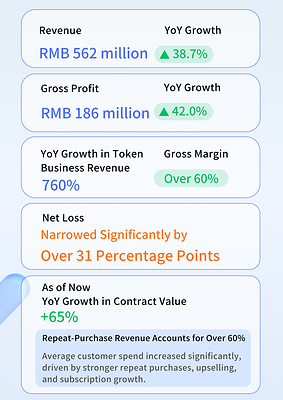
The results show that the company generated revenue of RMB 562 million in the first half of 2026, up 38.7% year over year, with commercialization accelerating across the board. Token business revenue increased by approximately 760% YoY, with a gross margin of over 60%, marking Unisound's entry into a phase of accelerated large-model commercialization as it moves from technological leadership toward value leadership.
Strategic Focus on Three Core Segments, Valuation Framework Shifts Toward a Platform Model
In the first half of 2026, Unisound sharpened its strategic focus on three core segments: Enterprise AI Services, Token Business, and Edge AI. Under the new structure, the company is moving beyond the label of a traditional AI project delivery provider and transforming comprehensively into an AI platform company. The value created by AI is no longer diluted by traditional businesses, fundamentally reshaping the company's valuation framework.
All three core segments delivered solid growth:
Enterprise AI Services: Comprising agent applications, agent platforms, and industry solutions, the segment generated RMB 478 million in revenue, up 35.7% YoY, further consolidating the company's industry-leading position.
Token Business: Revenue reached nearly RMB 30 million, with second-quarter revenue increasing by more than 500% quarter over quarter, making it a new growth engine for the company.
Edge AI: Revenue reached RMB 53.8 million, up 9.2% YoY, while overseas chip shipments increased 50% YoY, demonstrating strong growth resilience.
In terms of operating quality, revenue from repeat purchases accounted for more than 60% in the first half of the year, while average customer spend increased significantly. Repeat purchases and upselling from existing customers provided further support for revenue growth. During the reporting period, administrative expenses fell sharply by 37.8%, with all savings redirected to R&D. The net loss margin narrowed by more than 31 percentage points YoY, while overall gross margin remained stable with a modest increase. As of now, total contract value in 2026 has increased 65% YoY, the order backlog has exceeded RMB 1.5 billion, and cash reserves are approaching RMB 1.0 billion, making the path to profitability increasingly clear.
Architecture Upgrade Drives Platform Transformation, U2 Enters the Global Top Tier
During the reporting period, Unisound continued to enhance its three-layer architecture of "Foundation Capability Layer - Intelligent Construction Layer - Value Operation Layer." Its agent platform, UniAgentOS, has accumulated 1,773 agent instances, with a single module reused up to 119 times. Project implementation costs as a share of total costs fell from 21% in the same period last year to 17%. The revenue model has expanded beyond one-off project delivery to include platform subscriptions, usage-based calls, and ongoing operations, further strengthening revenue continuity.
On the technology front, Unisound has continued to expand the U-Model family around U2, driving ongoing breakthroughs in general-purpose foundation models, industry-specific models, and multimodal capabilities. Across the global LLM landscape, U2 has entered the top tier in multiple challenging benchmarks, spanning long-context understanding (AA-LCR), knowledge reasoning (GPQA Diamond), instruction following (IFBench), agent execution (SWE-bench Verified), and complex tasks (WildClawBench). Its overall performance ranks among the top 25 on LLM Stats and eighth among global model providers.
Going forward, Unisound will continue to pursue its "strong foundation models, deep applications" strategy, with a greater focus on post-training. The company will continue iterating U2 as well as models for the three healthcare domains, speech, and document intelligence. Leveraging its three-layer architecture, Unisound will further increase the reuse rate of agent modules and expand into more industries and regions. In a safe, compliant, and controllable manner, it will advance intelligence to greater heights and for the greater good, creating long-term value for society.
 View original content to download multimedia:https://www.prnewswire.co.uk/news-releases/unisound-2026-interim-results-revenue-up-38-7-yoy-token-business-surges-760-large-model-commercialization-accelerates-across-the-board-302862674.html

Ein umfangreicher Auswertungsbericht der Wirtschafts- und Korruptionsstaatsanwaltschaft (WKStA) zu digitalen Daten des verstorbenen Justiz-Spitzenbeamten Christian Pilnacek sorgt für neuen politischen und justizinternen Sprengstoff. Chatprotokolle, E-Mails und weitere Unterlagen zeichnen ein Bild tiefgreifender Konflikte innerhalb der Justiz – insbesondere zwischen der WKStA und Teilen der vorgesetzten Behörden. Parallel dazu bereitet ein parlamentarischer Untersuchungsausschuss die Befragung von Schlüsselpersonen vor, um mögliche politische Einflussnahmen auf Ermittlungen rund um Pilnacek und dessen Tod zu beleuchten.
Aus der von der WKStA erstellten Expertise zu Pilnaceks Kommunikationsdaten geht hervor, wie der langjährige Leiter der für Strafrecht zuständigen Sektion im Justizministerium über Jahre hinweg gegenüber der WKStA Stellung bezog. Der Bericht zeigt, dass der damalige Wiener Oberstaatsanwaltschef Johann Fuchs im Juni 2019 in einer internen Nachricht erklärte, er sehe es als Aufgabe seiner Amtszeit, eine von der WKStA angeblich offengelegte „Verkommenheit“ im Berufsstand „mit allen Mitteln zu bekämpfen“. Er bezeichnete Pilnacek darin ausdrücklich als Mitstreiter. In dem Gutachten findet sich zudem Material, aus dem hervorgehen soll, wie die Korruptionsstaatsanwaltschaft aufgelöst und neu aufgesetzt werden könnte.
Die Auswertung des Laptops und mehrerer Speichermedien Pilnaceks, die in einem rund 440 Seiten starken Bericht zusammengefasst wurde, behandelt auch seine Kontakte in das Umfeld der ÖVP. Der frühere Sektionschef war von 2010 bis 2020 über alle wesentlichen Strafsachen der Republik informiert und konnte als weisungsbefugter Beamter Ermittlungsschritte mitsteuern oder Berichte anfordern. Laut dem Bericht kooperierte er in dieser Zeit eng mit ÖVP-nahen Personen und wirkte an der Verteidigung von Beschuldigten mit. Nach Bekanntwerden einer Audioaufnahme aus dem Sommer 2023, in der Pilnacek Interventionen von ÖVP-Seite beklagte, leitete die WKStA ein Ermittlungsverfahren gegen unbekannte Täter ein; dieser Interventionsakt ist nun ebenfalls Gegenstand des U-Ausschusses.
Der Untersuchungsausschuss, der sich mit den Umständen von Pilnaceks Tod und dem Umgang der Behörden befasst, bekommt das WKStA-Dokument zeitlich passend zur nächsten Befragungsrunde vorgelegt. Zunächst soll ein IT-Experte der WKStA, der für das Auslesen von Datenträgern zuständig ist, Auskunft geben. In den darauffolgenden Tagen werden Exekutivbeamte befragt, darunter der Leiter des Bundeskriminalamts sowie zwei Polizeibeamte aus Niederösterreich, die unter anderem mit Pilnaceks Geisterfahrt Stunden vor dem Fund seiner Leiche in einem Donau-Seitenarm befasst waren. Politisch besonders im Fokus steht der Auftritt von Innenminister Gerhard Karner und dessen Kabinettschefin, nachdem eine vom Ressort in Auftrag gegebene Schulungsunterlage für geladene Auskunftspersonen parteiübergreifend – mit Ausnahme der ÖVP – auf Kritik gestoßen war.
Die Kombination aus internen Justizchats, detaillierter Datenauswertung und politischer Aufarbeitung im Parlament verschärft die Debatte über das Verhältnis zwischen Ministerien, Staatsanwaltschaften und Parteien. Während die WKStA ihre Auswertungsergebnisse in den U-Ausschuss einbringt, suchen Abgeordnete nach Antworten auf die Frage, ob und in welchem Ausmaß versucht wurde, auf Ermittlungen Einfluss zu nehmen – sowohl in prominenten Wirtschafts- und Korruptionsfällen als auch im Zusammenhang mit den Untersuchungen nach dem Tod eines der einflussreichsten Justizbeamten der vergangenen Jahre.