HONG KONG, June 12, 2026 /PRNewswire/ -- As global air cargo hubs confront rising e-commerce demand, labour shortages, and decarbonisation targets, Westwell—a global AI company advancing smart and green container logistics—is applying its "AI + New Energy (Ainergy)" strategy to airport operations. Serving over 200 customers across 30+ economies, Westwell now brings its AI-Native capabilities to air cargo, seaport, rail, land transport, and smart factories.
At the core is a dual-AI architecture: Physical AI enables frontline autonomous execution, while Operational AI drives intelligent decision-making.
Designed for demanding airside conditions, Westwell's Q-Tractor is powered by the self-developed Q-Pilot autonomous driving platform, integrating BEV perception and Transformer-based end-to-end models. Redundant safety architectures ensure 24/7 reliability in all weather and visibility conditions. Centimetre-level automatic trailer coupling and uncoupling—validated across multiple airport deployments—closes the last gap in unmanned logistics, enabling autonomous cargo loading and unloading. Powered by pure electric drive, the Q-Tractor achieves zero emissions in core operations.
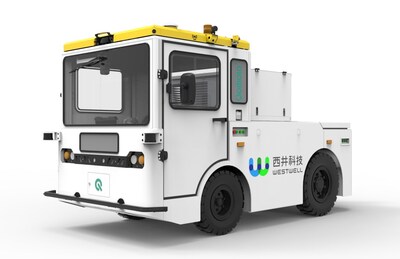
On the Operational AI layer, the ReeWell intelligent operations management platform, together with the WellFMS fleet management system, provides real-time dispatching, route optimisation, and coordinated decision-making across flights, cargo, vehicles, and energy resources—maximising fleet efficiency and capacity utilisation.
Westwell's solutions are being deployed at key air cargo hubs including Hong Kong International Airport, Hong Kong Air Cargo Terminals Limited (Hactl), Shanghai Pudong International Airport, Ezhou Huahu International Airport, and newly secured projects at Fuzhou Changle International Airport and Xiamen Xiang'an International Airport.
In 2025, Westwell officially received approval to deploy new energy autonomous tractors at Hactl - the largest independent air cargo handler in Hong Kong. Westwell's Q-Tractors power unmanned cargo transportation operations at the terminal, enhancing productivity while accelerating Hactl's smart and green transformation.
At Shanghai Pudong International Airport, Westwell is expanding AI applications into airport safety operations beyond cargo transportation - the company is developing an industry-leading "AI + Autonomous Driving + FOD Detection" intelligent runway inspection solution, combining autonomous vehicles, radar systems and AI recognition algorithms to support the safe operation of flights.
As airports continue balancing efficiency, resilience and sustainability targets, AI-Native operational systems are expected to play an increasingly strategic role in air cargo infrastructure development. For Westwell, the future of airport logistics lies not simply in automation, but in building collaborative ecosystems where people, intelligent vehicles and AI systems work together more safely, efficiently and sustainably.
Photo - https://mma.prnewswire.com/media/2996737/image2.jpg
 View original content:https://www.prnewswire.co.uk/news-releases/westwell-rebuilding-air-cargo-operations-through-ai-native-logistics-302798822.html

Die österreichische Steyr Motors AG baut ihr Geschäft im Bereich autonomer Verteidigungs- und Sicherheitssysteme aus und setzt damit auf einen der am schnellsten wachsenden Segmente der Rüstungsindustrie. Nach bereits realisierten Anwendungen in unbemannten Überwasserfahrzeugen (USV) kommen die Hochleistungsmotoren des Unternehmens nun auch in modernen unbemannten Bodenfahrzeugen (Unmanned Ground Vehicles, UGV) zum Einsatz. Im Zentrum steht dabei die Plattform CORNUS des slowenischen Spezialisten RTC, die künftig mit Antriebstechnologie von Steyr Motors ausgestattet wird.
Das CORNUS-UGV ist als modulare Plattform für anspruchsvolle Einsätze in militärischen und sicherheitsrelevanten Umgebungen ausgelegt. Es lässt sich flexibel für unterschiedliche Missionen konfigurieren, darunter Aufklärungsaufgaben, Logistiktransporte in schwierigem Gelände, die mobile Energieversorgung im Feld sowie die unmittelbare Unterstützung von Einsatzkräften. In all diesen Anwendungen sind Zuverlässigkeit, Robustheit und Ausfallsicherheit zentrale Anforderungen – Bereiche, in denen Steyr Motors auf jahrzehntelange Erfahrung aus Marine-, Spezialfahrzeug- und Defense-Anwendungen verweist.
Der Schritt in den UGV-Markt erfolgt vor dem Hintergrund eines breiten Trends hin zu autonomen und unbemannten Systemen. Weltweit investieren Streitkräfte verstärkt in autonome Aufklärungsplattformen, unbemannte Logistikfahrzeuge, ferngesteuerte Schutzsysteme und maritime Robotik, um Risiken für Soldaten zu verringern und gleichzeitig die operative Leistungsfähigkeit zu erhöhen. Ein jüngstes Beispiel für die wachsende Bedeutung solcher Technologien ist eine US-Rettungsaktion in der Straße von Hormus, bei der unbemannte Überwasserfahrzeuge zum Einsatz kamen und damit die Relevanz autonomer Fahrzeugplattformen unterstrichen haben.
Branchenanalysen veranschlagen das Volumen des globalen Marktes für unbemannte Systeme bis zum Jahr 2033 auf mehr als 67 Milliarden US-Dollar. Steyr Motors sieht sich als Technologiezulieferer gut positioniert, um von dieser Entwicklung zu profitieren. Das Unternehmen betont, dass das Wachstumspotenzial aus autonomen Defense-Lösungen im aktuellen Auftragsbestand erst in Ansätzen abgebildet ist. Der Einstieg in das CORNUS-Programm gilt vor diesem Hintergrund als weiterer Baustein, um die Präsenz im Zukunftsmarkt unbemannter Systeme deutlich auszubauen.