SEOUL, South Korea, April 9, 2026 /PRNewswire/ -- Kia Corporation (Kia) today shared its mid-to-long-term business strategies and financial targets at its 2026 CEO Investor Day held in Seoul, Korea.
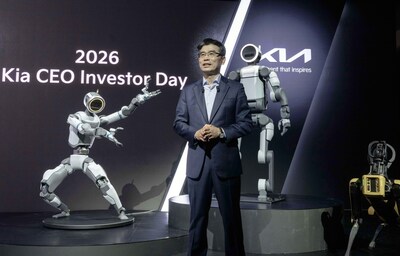
This year's event focused on reviewing the five-year progress of Kia's 'Total Transformation' initiative, following the company's brand relaunch in 2021. Kia also outlined its mid- to long-term growth roadmap across all business sectors.
"Building on the achievements of innovation across all areas over the past five years —including brand, EVs, PBVs, and ESG — EVs, HEVs, autonomous driving, and robotics will serve as key drivers for Kia's fastest growth to date. Even amid the evolving global environment, Kia will proactively respond to changing market conditions through differentiated strategies." – Ho Sung Song, President and CEO of Kia Corporation.
2030 Mid- to Long-Term Business Strategy
Kia aims to pursue a strategy to accelerate exponential growth, targeting global sales of 4.13 million units by 2030 with a 4.5 percent market share. This compares with a sales goal of 3.35 million units with a 3.8 percent market share in 2026.
Kia places customers at the centre of its business strategy and, over the mid- to long-term, the company intends to expand its mobility ecosystem with a strategic focus on PBVs, autonomous driving, and robotics, connecting people and infrastructure to drive enhanced value creation for both customers and wider society.
Overview of Key Announcements at Kia 2026 CEO Investor Day
Category | Content | ||
2030 | Global Sales Targets |
| |
ICE & HEV |
| ||
EV | Sales Target |
| |
Enhancing EV Product |
| ||
Improving EV Accessibility |
| ||
Strengthening |
| ||
PBV |
| ||
Regional | U.S. |
| |
Europe |
| ||
Emerging |
| ||
Future | Autonomous Driving |
| |
Robotics |
| ||
2026 Business Plan & |
| ||
For more information, visit the Kia Global Newsroom.
Photo - https://mma.prnewswire.com/media/2953023/Image_1__2026_Kia_CEO_Investor_Day.jpg
PDF - https://mma.prnewswire.com/media/2953024/Press_release__2026_Kia_CEO_Investor_Day.pdf
 View original content to download multimedia:https://www.prnewswire.co.uk/news-releases/2026-kia-ceo-investor-day-kia-to-drive-exponential-growth-and-manufacturing-innovation-by-expanding-its-full-electrified-vehicle-lineup-and-strengthening-future-business-capabilities-302738080.html

Mit einem neuen Reallabor für Künstliche Intelligenz (KI) positioniert sich die USTP – University of Applied Sciences St. Pölten als einer der zentralen Standorte für angewandte KI-Forschung in Niederösterreich. Das Land unterstützt das Gesamtprojekt mit einem Volumen von 1,2 Millionen Euro mit rund 600.000 Euro und verankert das Labor in einem breiter angelegten KI-Forschungsschwerpunkt. Insgesamt stellt Niederösterreich laut Landesangaben 6,35 Millionen Euro für KI-Initiativen bereit, darunter mehr als 20 Studiengänge mit KI-Bezug, zwei Stiftungsprofessuren zu Gesundheit und Landwirtschaft sowie zusätzliche Forschungsförderungen.
Im KI-Reallabor laufen die leistungsstärksten KI-Anwendungen der Hochschule. Die Einrichtung kombiniert Infrastruktur, wissenschaftliche Expertise und Demonstrationsumgebungen und versteht sich als offener Begegnungsraum. Ziel ist es, Studierende, Forschende und Unternehmenspartner zusammenzubringen, um gemeinsam neue Anwendungen zu entwickeln – von der Erprobung neuester Modelle bis hin zu prototypischen Lösungen für Branchen wie Gesundheitswesen, Medien oder Klimaanpassung. Das Labor soll ausdrücklich nicht nur Forschungsumgebung sein, sondern reale Einsatzszenarien abbilden.
Das Konzept der Öffnung reicht über klassische Kooperationen mit der Industrie hinaus: Die Hochschule will Bürgerinnen und Bürger gezielt in den Dialog einbeziehen und Berührungsängste mit KI-Anwendungen abbauen. Laut USTP arbeiten derzeit mehr als 60 Forschende an rund 25 Projekten mit KI-Bezug, die von der Erkennung von Falschinformationen über digitale Humanismus-Projekte bis hin zu Anwendungen im Gesundheitsbereich reichen. Die Aktivitäten haben in den vergangenen Jahren zu mehreren Auszeichnungen geführt, darunter Preise beim Innovationspreis Niederösterreich.
Wie die Brücke von der Forschung zur Praxis konkret aussehen kann, zeigte die USTP auch bei der diesjährigen Social Artificial Intelligence Night (SAINT) des Departments Informatik und Security. Unter dem Motto „Beyond the Paper: Real-World in Action“ diskutierten Fachleute aus Wissenschaft, Industrie und der österreichischen KI-Community aktuelle Projekte und Einsatzfelder. Ein Schwerpunkt lag auf effizienten Sprachmodellen: In ihrer Keynote erläuterte Loubna Ben Allal, Machine-Learning-Engineer bei der Plattform Hugging Face, die Trainingsstrategien für kompakte Modelle wie SmolLM 3, die trotz geringerer Ressourcenanforderungen leistungsfähige Anwendungen ermöglichen sollen. Sie unterstrich die Rolle kleiner, effizienter Modelle für alltägliche Aufgaben wie Textklassifikation, Dokumentenzusammenfassungen oder sicheres Routing von Anfragen – insbesondere für Unternehmen, die aus Datenschutz- oder Sicherheitsgründen auf eigene, ressourcenschonende Systeme setzen.