CLARK, N.J., April 10, 2026 /PRNewswire/ -- GEP Global Supply Chain Volatility Index — a leading indicator tracking demand conditions, shortages, transportation costs, inventories and backlogs, based on a monthly survey of 27,000 businesses — signaled that global supply chain pressures rose to a three-year high in March, reflecting the immediate economic impact of the energy price shock and maritime disruption caused by the war in the Middle East.
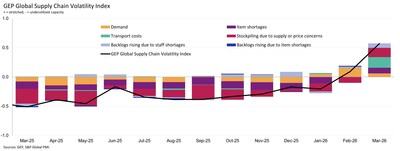
The GEP Global Supply Chain Volatility Index soared from 0.09 in February to 0.57 in March, its highest level since January 2023.
In March, global manufacturers increase safety stockpiling in response to maritime disruption, higher transportation costs and supplier price increases. Reports of inventory buffers being accumulated were the highest in three years, with increases across all major regions.
Uncertainty resulting from the conflict weighed on manufacturers' input demand, with factories around the world cutting purchasing volumes. Notably, item shortages hit a three-year high despite slowing demand, signaling the emergence of bottlenecks, with the availability of materials such as polymers, PVC and rubber, as well as energy-intensive metals such as aluminum and copper reportedly deteriorating the most.
Surging oil prices pushed global transportation costs to a four-year high in March. The impact was felt globally, but especially strongly in Asia, given its reliance on Middle East oil. Taiwan, Vietnam, South Korea and Japan reported surging producer price inflation during March.
"The war is pushing up costs, triggering stockpiling and creating shortages across supply chains, but it has not yet escalated into a broad-based shock that materially slows global economic growth," said Mukund Acharya, vice president, consulting, GEP. "Companies need to secure supply where it matters most while avoiding broad stockpiling that can lock in higher costs."
Interpreting the data:
Index > 0, supply chain capacity is being stretched. The further above 0, the more stretched supply chains are.
Index < 0, supply chain capacity is being underutilized. The further below 0, the more underutilized supply chains are.
Interpreting the data:
Index > 0, supply chain capacity is being stretched. The further above 0, the more stretched supply chains are.
Index < 0, supply chain capacity is being underutilized. The further below 0, the more underutilized supply chains are.
MARCH 2026 REGIONAL KEY FINDINGS
MARCH 2026 KEY FINDINGS
For more information, visit www.gep.com/volatility.
Note: Full historical data dating back to January 2005 is available for subscription. Please contact economics@spglobal.com.
The next release of the GEP Global Supply Chain Volatility Index will be 8 a.m. ET, May 12, 2026.
About the GEP Global Supply Chain Volatility Index
The GEP Global Supply Chain Volatility Index is produced by S&P Global and GEP. It is derived from S&P Global's PMI® surveys, sent to companies in over 40 countries, totaling around 27,000 companies. The headline figure is a weighted sum of six sub-indices derived from PMI data, PMI Comments Trackers and PMI Commodity Price & Supply Indicators compiled by S&P Global.
A Supply Chain Volatility Index is also published at a regional level for Europe, Asia, North America and the U.K. For more information about the methodology, click here.
Media Contacts
Derek Creevey | Joe Hayes | S&P Global Market Intelligence |
Director, Public Relations | Principal Economist | Corporate Communications |
GEP | S&P Global Market Intelligence | Email: Press.mi@spglobal.com |
Phone: +1 646-276-4579 | Phone: +44-1344-328-099 | |
Email: derek.creevey@gep.com | Email: joe.hayes@spglobal.com |
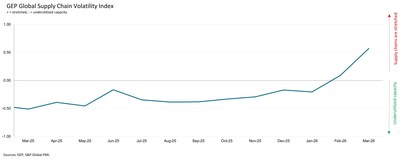
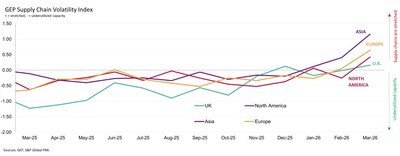

Photo - https://mma.prnewswire.com/media/2953258/GEP_SCVI_breakdown.jpg
Photo - https://mma.prnewswire.com/media/2953259/GEP_SCVI_headline.jpg
Photo - https://mma.prnewswire.com/media/2953260/SCVI_ALL.jpg
Logo - https://mma.prnewswire.com/media/518346/GEP_Logo.jpg
 View original content:https://www.prnewswire.co.uk/news-releases/middle-east-war-drives-global-supply-chain-pressures-to-a-three-year-high-gep-global-supply-chain-volatility-index-302738828.html

Die Porsche Holding Salzburg hat 2025 das beste Geschäftsjahr ihrer Firmengeschichte erzielt und ist nach 2020 erneut zum umsatzstärksten Unternehmen Österreichs aufgestiegen. Der Umsatz kletterte von 28,7 Milliarden Euro im Jahr 2024 auf 40,7 Milliarden Euro, ein Plus von gut 42 Prozent. Das Automobilhandelsunternehmen ist von Salzburg aus in 29 Ländern auf drei Kontinenten aktiv und profitiert zunehmend von seiner breiten internationalen Aufstellung.
Haupttreiber des Sprungs war die Übernahme der Großhandelsverantwortung für die Volkswagen-Konzernmarken in Italien und Schweden. Beide neuen Märkte steuerten 2025 zusammen mehr als ein Viertel zum Gesamtumsatz bei und ließen die Holding bei Stückzahlen und Erlösen in neue Dimensionen wachsen. Im Großhandel verdoppelte sich der Umsatz dank der zusätzlichen Absatzmärkte von 11,3 Milliarden Euro auf 24,6 Milliarden Euro. Der Neuwagenabsatz im Groß- und Einzelhandel legte um 65,6 Prozent auf 912.034 Fahrzeuge zu.
Auch ohne Italien und Schweden fällt die Bilanz der vergangenen Jahre deutlich positiv aus. Seit Beginn der Pandemie 2020 erhöhte die Porsche Holding ihren Umsatz in den bestehenden Märkten von 21,5 Milliarden Euro auf 30,8 Milliarden Euro. Im Einzelhandel gelang es, das Ergebnis 2025 trotz volatiler Rahmenbedingungen, schärferem Wettbewerb und spürbaren Rückgängen in China leicht zu übertreffen; der Umsatz stieg hier minimal auf 20 Milliarden Euro. Im traditionell starken Markt China verzeichnete die Holding dagegen bereits das dritte Jahr in Folge deutliche Umsatzrückgänge, was ein noch besseres Einzelhandelsresultat verhinderte.
Die Zahl der Mitarbeiter blieb trotz des massiven Umsatzanstiegs weitgehend stabil. Weltweit beschäftigte die Porsche Holding 2025 rund 36.917 Menschen, ein Rückgang von lediglich 0,3 Prozent. Die Zahl der Händlerstandorte verringerte sich um elf auf 487. Vorstandssprecher Hans Peter Schützinger betonte, dass für das Unternehmen nicht die reine Umsatzgröße im Vordergrund stehe, sondern Kundenzufriedenheit, Profitabilität, Effizienz und Resilienz. Das Geschäftsmodell habe sich 2025 angesichts angespannter wirtschaftlicher und politischer Rahmenbedingungen als widerstandsfähig erwiesen; die vollständige Abdeckung der automobilen Wertschöpfungskette ermögliche es, regionale Marktschwankungen innerhalb der Unternehmensgruppe auszugleichen.