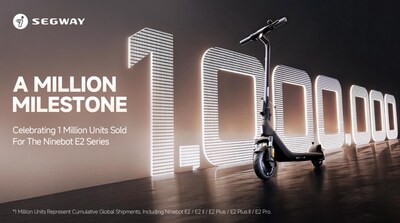
Driven by Deep R&D Investment and User-Centric Engineering, the Company Reinforces Its Global Leadership in Micromobility with A New Milestone Achieved
BEIJING, April 22, 2026 /PRNewswire/ -- Segway, a global leader in personal mobility and service robotics, today announced that cumulative global sales of its Ninebot E2 series electric kickscooters have surpassed one million units [1], solidifying its position in the entry-level electric kick scooter segment.
This achievement reflects a broader shift in urban mobility patterns. Electric scooters are increasingly becoming a preferred solution to short-distance commuting for an expanding audience. For three consecutive years (2023-2025), Segway has ranked as the Global No. 1 brand in electric kickscooter sales [2]. With over 15 million units shipped worldwide, the Company has cemented its leadership in the expanding micromobility market [3].
Designed for First-Time Riders, Built for Everyday Mobility
The Segway Ninebot E2 series was developed based on extensive user insights, with a particular focus on the needs of new riders entering the micromobility ecosystem. The product prioritizes accessibility and rider confidence, featuring a compact, portable design, a lightweight yet durable frame, and stable handling for improved control.
Building on these insights, Segway has introduced the next-generation Ninebot E3 Series, engineered to address a broader range of urban commuting scenarios. Key upgrades include a more powerful powertrain for improved hill-climbing performance and extended range; a lightweight aluminum-magnesium frame with a quick-folding mechanism for enhanced portability; and a self-developed dual-elastomer suspension designed to reduce road vibrations—effectively delivering a more comfortable, stable, and intuitive riding experience.
Integrated Innovation System Driving Continuous Product Evolution
Segway's product development is powered by an Integrated Product Development (IPD) framework that integrates research and development, design, manufacturing, and dynamic user feedback. The Company employs over 2,000 engineers and continues to invest heavily in product and technology innovation, with R&D funding reaching USD 174 million in 2025—a significant 51% year-on-year increase [4].
These proprietary technology platforms encompass the SegRide™ Riding Safety and Smart Assist Technologies, SegRange™ High-Efficiency Long-Range Technologies, and SegSmart™ Smart Interaction Technologies, which form the core of its electric scooter portfolio's technology. Further innovations, such as TurboTuned™ for e-bike battery efficiency and motor performance optimization and Self-Balancing Technology 2.0 for e-mopeds balance assistance, also reinforce the Company's multi-category technology leadership.
In 2025, Segway also obtained witness laboratory accreditation from TÜV Rheinland and Bureau Veritas, enabling selected certification tests to be completed in Segway's internal laboratory.
Strong Financial Performance Reflects Market Validation
Segway's user-focused strategy has yielded significant commercial returns, reporting revenue of USD 2.98 billion in 2025—a 49.9% year-over-year increase [5]. This growth underscores robust market demand and the success of its business strategy. In the same year, Segway sold more than 5.55 million vehicles globally across multiple product categories, including e-scooters, e-bikes and e-mopeds [6].
Expanding Global Presence and Long-Term Vision
Today, Segway's products empower riders across over 160 countries and regions. As the micromobility market continues to evolve, the Company's sustained leadership hinges on its dedication to user value and its vision of green, and smart mobility for all.
Guided by this vision, Segway aims to bring innovative personal transportation to one billion people worldwide, solidifying its long-term commitment to sustainable mobility.
About Segway
Segway transformed micromobility in 1999 with the revolutionary Personal Transporter, igniting global curiosity about the future of personal transportation. With a mission of "Simply Moving," Segway is dedicated to simplifying how people and goods move, improving efficiency, and enhancing the overall experience of everyday life.
For decades, Segway has continuously set new benchmarks in short-distance transportation and consumer robotics, constantly pushing the boundaries of innovation. Today, as the global leader in micromobility solutions, Segway's offering have evolved far beyond its origins. From e-scooters and GoKarts to e-bikes, powersports vehicles, and personal robots, Segway is pioneering the future of mobility with breakthrough technology, delivering innovative products that redefine the way we move. Discover more at www.segway.com.
[1] 1 million units represent cumulative global shipments, including Ninebot E2, E2 II, E2 Plus, E2 Plus II, and E2 Pro. [2] Data source: Euromonitor International (Shanghai) Limited; measured in terms of the global sales value of electric kickscooter brands in 2023-2025 respectively. Electric kickscooter refers to a means of light transport, which consists of handlebar, wheels, footboard and is equipped with additional components including motor, controller, battery and throttle compared with a conventional non-motorized scooter; research completed in Feb 2026. [3] Data source: The 15 million sales volume mentioned in the release is based on the internal database of Segway-Ninebot, which refers to Segway, Ninebot and their global affiliates. [4][5][6] Data source: Segway-Ninebot's 2025 Financial Report. USD conversion based on the full-year average CNY/USD rate of 7.1429. |
Photo - https://mma.prnewswire.com/media/2962875/image_5018219_10023021.jpg
 View original content:https://www.prnewswire.co.uk/news-releases/segway-announces-1-million-units-sold-of-its-ninebot-e2-series-electric-kick-scooters-worldwide-302750055.html

Steyr Motors AG hat auf ihrer ordentlichen Hauptversammlung für das Geschäftsjahr 2025 die Weichen für die weitere Unternehmensentwicklung gestellt und zugleich ihre Aktionäre am Gewinn beteiligt. Das auf maßgeschneiderte Motoren für einsatzkritische militärische und zivile Anwendungen spezialisierte Unternehmen zahlt eine Dividende von 0,25 Euro je Aktie. Insgesamt werden damit 1,3 Millionen Euro aus dem zum 31. Dezember 2025 ausgewiesenen Bilanzgewinn von 8,12 Millionen Euro an die Anteilseigner ausgeschüttet, der Rest wird auf neue Rechnung vorgetragen. Sämtliche zur Abstimmung stehenden Tagesordnungspunkte wurden laut Unternehmen mit großer Mehrheit angenommen.
Parallel dazu wurde der Aufsichtsrat "planmäßig neu aufgestellt". Mit Rolf Wirtz, ehemaliger CEO von thyssenkrupp Marine Systems, und Gerhard Schwartz, zuletzt Managing Partner bei EY, ziehen zwei ausgewiesene Industrie- und Kapitalmarktexperten in das Kontrollgremium ein. Wirtz wurde in der konstituierenden Sitzung des Gremiums zum Vorsitzenden des Aufsichtsrats gewählt. Schwartz soll als designierter Vorsitzender des Prüfungsausschusses insbesondere die Weiterentwicklung der Finanz- und Kontrollstrukturen des börsennotierten Unternehmens begleiten.
Die Neubesetzung folgt auf den Ausstieg der deutschen Beteiligungsgesellschaft Mutares, nach dem Christian Klingler und Fabian Schlegel nicht mehr zur Wiederwahl antraten. Für Kontinuität im Gremium sorgt Alexander Fitzka, Investment Manager der B-&-C-Gruppe: Er gehört dem Aufsichtsrat bereits seit August 2025 an und wurde von der Hauptversammlung erneut bestätigt. Damit kombiniert das neue Kontrollgremium Industrie-Know-how aus dem maritimen Bereich, Erfahrung im Kapitalmarkt- und Prüfungsumfeld sowie die Perspektive eines langfristig orientierten Kernaktionärs.
Operativ sieht sich Steyr Motors für zusätzliches Wachstum gerüstet. Das Management verweist insbesondere auf die M12 Power Unit als neue Produktkategorie, die zusammen mit Anwendungen in unbemannten maritimen Systemen (USV) weiteres Potenzial über das bisherige Budget hinaus eröffnen soll. Als einer der weltweit führenden Anbieter von Spezialmotoren im Defense- und Zivilbereich zielt das Unternehmen damit auf einen Ausbau seines Technologie- und Marktprofils, während es mit der beschlossenen Gewinnausschüttung zugleich ein Signal der Verlässlichkeit an die Kapitalmärkte sendet.