BRASILIA, Brazil, April 22, 2026 /PRNewswire/ -- To really grasp what Cristian Ribera and Aline Rocha pulled off at the Paralympic Winter Games Milano Cortina 2026, you have to look at the ground they train on. Hint: it's not snow.
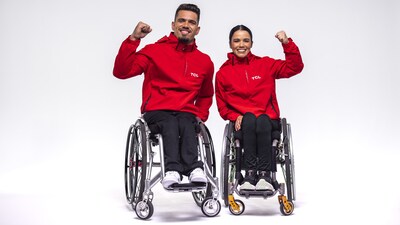
Ribera, 23, recently made history by securing a silver medal in the Men's Sprint Sitting cross-country skiing event—becoming the first South American athlete ever to reach a Winter Paralympic Games podium. Rocha grabbed an impressive 5th-place finish in the Women's Sprint Sitting, setting a new benchmark for Brazilian women.
Cheering on their success was TCL, the Worldwide Olympic and Paralympic Partner in the Home Audiovisual Equipment and Home Appliances category, which supports Ribera and Rocha as part of Team TCL. The lineup includes other world-renowned athletes such as freestyle skier Eileen Gu and snowboarder Ayumu Hirano. Each embodies the drive to push further, echoing TCL's own commitment to empower people to pursue greatness in their own lives.
For Ribera and Rocha, that journey to greatness began not on icy peaks, but on the sun-baked pavement back home.
"In Brazil, we train using roller skis, which are widely used in Europe during the summer," Ribera says. "We train almost all year round on asphalt, and that is very similar to what we do on snow. To give you an idea, last year I trained around 5,000 kilometers. So we train a lot in order to arrive on the snow ready to perform and adapt quickly."
Taking that raw, dry-land power onto the snow is a massive shock to the system. On pavement, athletes use their poles simply to push forward. On snow, the gear is hypersensitive—a balancing act that takes years of bruising practice to nail down.
Then, there is the environment. When Ribera first hit the Swedish snow for training in December 2016, the Nordic winter delivered a jarring culture shock.
"I remember my first training session: it was around 2:30 or 3:00 in the afternoon, and it was already dark," Ribera recalls. "That was very strange for me, because in Brazil during the summer we have sunlight until around 7:00 p.m. It was a very different experience, but a very good one."
Rocha's initiation was even harsher. At her first international event in Ukraine, the thermometer plunged to -28°C. She crashed repeatedly, fighting through conditions totally alien to her background. But she crossed the finish line anyway, effectively pushing the door open for other Brazilian Paralympians to chase the Winter Paralympics circuit.
Ahead of Milano Cortina 2026, the two got a massive boost when TCL, a leading global technology company, stepped in to sponsor them. The move was part of the brand's support to elevate how people enjoy the Olympic and Paralympic Games. This included providing expertise and equipment to the International Broadcast Centre to support the smooth delivery of a seamless viewing experience, as well as smart appliances such as washing machines that enhanced the comfort of the Olympic Village. TCL even prepared a suite of televisions tested to withstand the event's challenging conditions so that athletes could connect with loved ones after each event as part of the Athlete Moment.
The sponsorship was a rare win in a sport where athletes usually spend much of their time just hunting for funding.
"When TCL contacted me on Instagram, I even thought it might be fake," Ribera says. "But when I realized it was real, I was very happy. It was the first major brand to reach out to us. Receiving that support one year before Milano Cortina 2026 gave us even more motivation and showed that our work and our results were being recognized."
While consumer technology doesn't make a carbon-fiber sit-ski glide faster, the brand's support fundamentally changed how both athletes operate on a daily basis.
"TCL's large-screen Mini LED TVs, with their incredible clarity, help us watch our training sessions and analyze our technique, seeing where we can improve," Ribera explains. Practical appliances from TCL such as air conditioners, refrigerators, washers, dryers and more, have helped the athletes optimize their home routines to focus on their training. More than the hardware, though, the psychological lift propelled them to success. "The mental impact is very strong, because now we can say that we are TCL partners. That makes a difference. We have a big team behind us."
Having a global brand in their corner ties directly into TCL's core mission to "Inspire Greatness"—something both athletes already live by. Rocha doesn't divide her life by the car accident that put her in a wheelchair; she divides it into "before and after sport." Sport gave her independence, a chance to travel the world, and a powerful platform.
Now, she's passing that platform on. After watching Rocha and Ribera compete, a 12-year-old girl in Brazil recently decided to try wheelchair sports. To get her started, Rocha's husband and coach is actually restoring Rocha's very first racing chair so the young girl can use it.
"The most important thing is to show other children and other people that we can do whatever we want," Ribera says. "Just because we are in a wheelchair does not mean we cannot achieve our dreams. The first big battle is believing that you can do it."
With historic performances in Milan now in the rearview, neither athlete is taking a breather. Along with TCL, they are already eyeing the Paralympic Games Los Angeles 2028 for wheelchair athletics, while keeping a firm grip on the next winter cycle.
"In 2030," Ribera promises, "we are going after even more medals."

Photo - https://mma.prnewswire.com/media/2962920/Photo_1_for_release.jpg
Logo - https://mma.prnewswire.com/media/2748692/5931178/Picture1__1_Logo.jpg
 View original content:https://www.prnewswire.co.uk/news-releases/from-asphalt-to-the-alps-how-brazilian-paralympians-redefined-winter-sports-supported-as-part-of-team-tcl-302749933.html

Steyr Motors AG hat auf ihrer ordentlichen Hauptversammlung für das Geschäftsjahr 2025 die Weichen für die weitere Unternehmensentwicklung gestellt und zugleich ihre Aktionäre am Gewinn beteiligt. Das auf maßgeschneiderte Motoren für einsatzkritische militärische und zivile Anwendungen spezialisierte Unternehmen zahlt eine Dividende von 0,25 Euro je Aktie. Insgesamt werden damit 1,3 Millionen Euro aus dem zum 31. Dezember 2025 ausgewiesenen Bilanzgewinn von 8,12 Millionen Euro an die Anteilseigner ausgeschüttet, der Rest wird auf neue Rechnung vorgetragen. Sämtliche zur Abstimmung stehenden Tagesordnungspunkte wurden laut Unternehmen mit großer Mehrheit angenommen.
Parallel dazu wurde der Aufsichtsrat "planmäßig neu aufgestellt". Mit Rolf Wirtz, ehemaliger CEO von thyssenkrupp Marine Systems, und Gerhard Schwartz, zuletzt Managing Partner bei EY, ziehen zwei ausgewiesene Industrie- und Kapitalmarktexperten in das Kontrollgremium ein. Wirtz wurde in der konstituierenden Sitzung des Gremiums zum Vorsitzenden des Aufsichtsrats gewählt. Schwartz soll als designierter Vorsitzender des Prüfungsausschusses insbesondere die Weiterentwicklung der Finanz- und Kontrollstrukturen des börsennotierten Unternehmens begleiten.
Die Neubesetzung folgt auf den Ausstieg der deutschen Beteiligungsgesellschaft Mutares, nach dem Christian Klingler und Fabian Schlegel nicht mehr zur Wiederwahl antraten. Für Kontinuität im Gremium sorgt Alexander Fitzka, Investment Manager der B-&-C-Gruppe: Er gehört dem Aufsichtsrat bereits seit August 2025 an und wurde von der Hauptversammlung erneut bestätigt. Damit kombiniert das neue Kontrollgremium Industrie-Know-how aus dem maritimen Bereich, Erfahrung im Kapitalmarkt- und Prüfungsumfeld sowie die Perspektive eines langfristig orientierten Kernaktionärs.
Operativ sieht sich Steyr Motors für zusätzliches Wachstum gerüstet. Das Management verweist insbesondere auf die M12 Power Unit als neue Produktkategorie, die zusammen mit Anwendungen in unbemannten maritimen Systemen (USV) weiteres Potenzial über das bisherige Budget hinaus eröffnen soll. Als einer der weltweit führenden Anbieter von Spezialmotoren im Defense- und Zivilbereich zielt das Unternehmen damit auf einen Ausbau seines Technologie- und Marktprofils, während es mit der beschlossenen Gewinnausschüttung zugleich ein Signal der Verlässlichkeit an die Kapitalmärkte sendet.