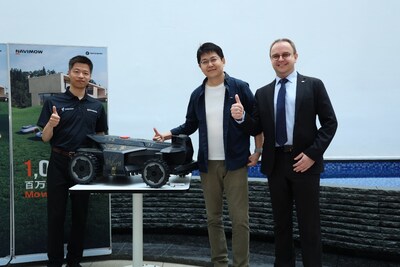
CHANGZHOU, China, April 28, 2026 /PRNewswire/ -- Global robotic lawn mower leader Segway Navimow has produced it's one millionth unit. The organization held a ceremony at its research and development and manufacturing base in China to celebrate the milestone. The announcement comes as Navimow launches its new production line in Malaysia, providing a solid foundation for global supply chain stability and delivery efficiency.
Commenting on the achievement, Segway Navimow CEO George Ren said: "This milestone is just the beginning. We hope to become a model for 'new quality productivity' going global, making 'made in China' synonymous with efficiency, reliability, and sustainability in the home."
Behind the cumulative mass production of 1 million units lies real market demand and a testament to supply chain management capabilities. Riding this momentum, Navimow has also been named "the World's No. 1 brand in wire-free robotic lawn mower retail volume sales for two consecutive years"*.
Breaking through the 1-million-unit milestone marks Navimow's official transition from category pioneer to global leader in wire-free robotic lawn mowers.
From "World's First" to "World's No.1": A Global Product Portfolio with Two Consecutive Years of Sales Leadership
To date, as a leading brand in wire-free robotic lawn mowers, Navimow's sales network covers more than 40 countries and regions, with over 5,000 offline retail stores worldwide, creating smarter, more efficient, and more sustainable yard-living for families around the globe.
Thanks to sustained investment in technology, channels, and service delivery, the brand has reaped the dual rewards of reputation and sales. During Amazon Prime Day and Black Friday in 2025, it ranked No.1 in its sub-category across six European countries.
From "Thousands of Units" to "One Million Units": Dual-Base Collaboration and Fully Validated Mass Delivery Capability
Behind the mass production of 1 million units lies Navimow's supply chain and manufacturing capabilities covering the entire chain from R&D and production to delivery. Today, Navimow's two major manufacturing bases in Changzhou and Nantong are equipped with intelligent, large-scale engineering and manufacturing capabilities. The newly launched Malaysia production line ensures stable delivery to European and American markets while preparing production capacity for further global expansion.
From the initial delivery of thousands of units in 2022, to steadily increasing sales year by year, and now to the cumulative mass production of 1 million units, Navimow has maintained continuous growth momentum, with its supply chain and manufacturing capabilities fully validated through mass delivery.
Facing the vast global market for wire-free robotic lawn mowers, Navimow will continue to be driven by technological innovation, centered on user needs, and leverage its unique R&D efficiency and supply chain capabilities to respond quickly to the real needs of global users.
-ENDS-
About Segway Navimow
Segway Navimow, a subsidiary of Ninebot Limited (Stock Code: 689009), is a high-tech enterprise focused on intelligent service robots. Committed to integrating next-generation innovations into everyday life, the brand strives to become the world's premier wire-free intelligent robotic lawn mower brand. Its product lineup spans the i, H, X, and commercial-grade Terranox Series, catering to diverse lawn sizes and scenarios. As a leading brand in the global robotic lawn mower market, Navimow is available in over 40 countries and regions, including Europe, North America, and Australia.
CONTACT:
Cassie Wang
heng.wang@ninebot.com
+86-13717799663
Photo - https://mma.prnewswire.com/media/2966052/image1.jpg
 View original content:https://www.prnewswire.co.uk/news-releases/segway-navimow-reaches-1-million-units-in-global-cumulative-mass-production-302753929.html

Mit einem neuen Reallabor für Künstliche Intelligenz (KI) positioniert sich die USTP – University of Applied Sciences St. Pölten als einer der zentralen Standorte für angewandte KI-Forschung in Niederösterreich. Das Land unterstützt das Gesamtprojekt mit einem Volumen von 1,2 Millionen Euro mit rund 600.000 Euro und verankert das Labor in einem breiter angelegten KI-Forschungsschwerpunkt. Insgesamt stellt Niederösterreich laut Landesangaben 6,35 Millionen Euro für KI-Initiativen bereit, darunter mehr als 20 Studiengänge mit KI-Bezug, zwei Stiftungsprofessuren zu Gesundheit und Landwirtschaft sowie zusätzliche Forschungsförderungen.
Im KI-Reallabor laufen die leistungsstärksten KI-Anwendungen der Hochschule. Die Einrichtung kombiniert Infrastruktur, wissenschaftliche Expertise und Demonstrationsumgebungen und versteht sich als offener Begegnungsraum. Ziel ist es, Studierende, Forschende und Unternehmenspartner zusammenzubringen, um gemeinsam neue Anwendungen zu entwickeln – von der Erprobung neuester Modelle bis hin zu prototypischen Lösungen für Branchen wie Gesundheitswesen, Medien oder Klimaanpassung. Das Labor soll ausdrücklich nicht nur Forschungsumgebung sein, sondern reale Einsatzszenarien abbilden.
Das Konzept der Öffnung reicht über klassische Kooperationen mit der Industrie hinaus: Die Hochschule will Bürgerinnen und Bürger gezielt in den Dialog einbeziehen und Berührungsängste mit KI-Anwendungen abbauen. Laut USTP arbeiten derzeit mehr als 60 Forschende an rund 25 Projekten mit KI-Bezug, die von der Erkennung von Falschinformationen über digitale Humanismus-Projekte bis hin zu Anwendungen im Gesundheitsbereich reichen. Die Aktivitäten haben in den vergangenen Jahren zu mehreren Auszeichnungen geführt, darunter Preise beim Innovationspreis Niederösterreich.
Wie die Brücke von der Forschung zur Praxis konkret aussehen kann, zeigte die USTP auch bei der diesjährigen Social Artificial Intelligence Night (SAINT) des Departments Informatik und Security. Unter dem Motto „Beyond the Paper: Real-World in Action“ diskutierten Fachleute aus Wissenschaft, Industrie und der österreichischen KI-Community aktuelle Projekte und Einsatzfelder. Ein Schwerpunkt lag auf effizienten Sprachmodellen: In ihrer Keynote erläuterte Loubna Ben Allal, Machine-Learning-Engineer bei der Plattform Hugging Face, die Trainingsstrategien für kompakte Modelle wie SmolLM 3, die trotz geringerer Ressourcenanforderungen leistungsfähige Anwendungen ermöglichen sollen. Sie unterstrich die Rolle kleiner, effizienter Modelle für alltägliche Aufgaben wie Textklassifikation, Dokumentenzusammenfassungen oder sicheres Routing von Anfragen – insbesondere für Unternehmen, die aus Datenschutz- oder Sicherheitsgründen auf eigene, ressourcenschonende Systeme setzen.


